🍕 Slices per Large Pizza Calculator
Estimate how many slices a large pizza makes from diameter, cut pattern, slice angle, crust loss, party size, appetite, and serving style.
Start with a common large pizza cut or party setting, then adjust the diameter, slice angle, appetite, crust loss, and serving style.
| Diameter | Radius | Area formula | Area result | Common large cut | Typical use |
|---|---|---|---|---|---|
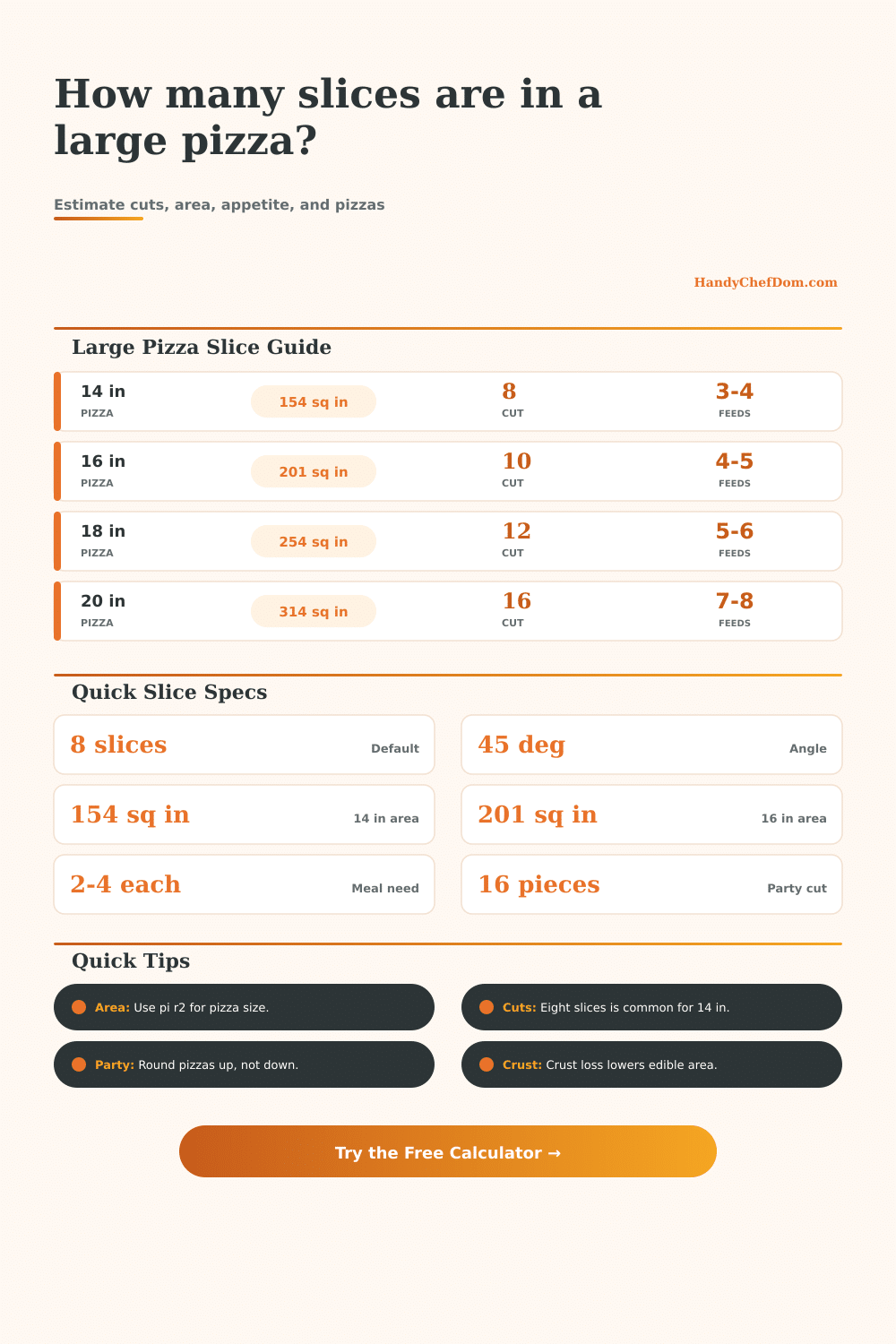
| 12 inches | 6 inches | pi x 6 x 6 | 113 sq in | 8 slices | Medium pizza, small group. |
| 14 inches | 7 inches | pi x 7 x 7 | 154 sq in | 8 slices | Standard large pizza. |
| 16 inches | 8 inches | pi x 8 x 8 | 201 sq in | 10 slices | Extra-large pizza. |
| 18 inches | 9 inches | pi x 9 x 9 | 254 sq in | 12 slices | Jumbo party pizza. |
| 20 inches | 10 inches | pi x 10 x 10 | 314 sq in | 16 slices | Very large party pizza. |
| Cut pattern | Pieces | Angle per wedge | Best for | Planning note |
|---|---|---|---|---|
| 6-slice hearty wedge | 6 | 60° | Deep dish or very hungry eaters | Large slices reduce piece count. |
| 8-slice standard wedge | 8 | 45° | Most 14 inch large pizzas | The default large pizza cut. |
| 10-slice thin wedge | 10 | 36° | Large thin crust pizzas | Smaller pieces improve sharing. |
| 12-slice small wedge | 12 | 30° | Large groups and mixed toppings | Easy to split among guests. |
| 16-piece party cut | 16 | 22.5° equivalent | Kids, buffets, and grazing tables | Pieces are not always equal wedges. |
| Serving style | Light appetite | Average appetite | Hearty appetite | Extra hungry | Use case |
|---|---|---|---|---|---|
| Snack or appetizer | 1 slice | 1.5 slices | 1.9 slices | 2.3 slices | Pizza before another meal. |
| Main meal with sides | 2 slices | 2.7 slices | 3.4 slices | 4 slices | Common family or casual meal. |
| Pizza is the only food | 2.4 slices | 3.2 slices | 4 slices | 4.8 slices | Order more when sides are absent. |
| Mostly kids | 1 slice | 1.4 slices | 1.8 slices | 2.1 slices | Best with smaller party pieces. |
| Late-night crowd | 2.6 slices | 3.5 slices | 4.4 slices | 5.3 slices | Plan extra backup slices. |
| Crust loss | 14 inch edible area | 8-slice area | 10-slice area | 12-slice area | What changes |
|---|---|---|---|---|---|
| 0% | 154 sq in | 19.2 sq in | 15.4 sq in | 12.8 sq in | Whole pizza area counted. |
| 5% | 146 sq in | 18.3 sq in | 14.6 sq in | 12.2 sq in | Small uneaten crust ring. |
| 10% | 139 sq in | 17.3 sq in | 13.9 sq in | 11.5 sq in | Common crust waste estimate. |
| 15% | 131 sq in | 16.3 sq in | 13.1 sq in | 10.9 sq in | Thicker crust or picky eaters. |
| 25% | 115 sq in | 14.4 sq in | 11.5 sq in | 9.6 sq in | Big crust loss affects servings. |
It’s six PM and you are staring at an empty fridge. You know what they say: good intentions won’t feed eight. If you’re going to do this thing, you’ve got to get out the geometry set. Pizza math seems easy; after all, it’s all in the box. Large is large, isn’t it? Not exactly. Two inches doesn’t sound like much when sitting on pizza shelf, but that’s close to fifty square inches of additional crust and cheese. Thirty percent more food for maybe four dollars more at the register. You won’t care about that until eight hungry teenagers come home from soccer practice.
Pizza ordering can be reduced to a single sentence: It’s a logistics problem pretending to be a comfort food decision. How much do I need? What shape should it be? Do we want one big piece or several smaller ones? Can we afford it? Will anyone really finish their slice? But what if there was an automated way to figure this out before you order? Enter the pizza party calculator above. After you plug in “serving style” and “party size,” it does all the hard work.
How to Order the Right Amount of Pizza
But first, let’s go over what these inputs mean, and how to avoid making these rookie mistakes. The most neglected input is crust loss. This value is 0% if everyone eats every bite of their pizza, even down to the last, thinnest scrap of crust. Adjust this number accordingly. You are not going to get full area listed on the box if you have some picky eaters or ordered a thick crust. Get it right here and the calculator will show you how much actual pizza you’ll be eating. A little tweak, sure, but at least no one starves by the end of the night.
That’s the thing: it doesn’t matter how big or small the pie itself is; what matters is how you cut the pie, which changes both mathematically and socialy. An eight-slice cut is perfect when you’re feeding a family and everybody wants a decent-sized slice. For a party with twenty people grazing, however, each slice goes in too quickly and you bottleneck the table. Using a party cut with sixteen pieces, however, while having exactly the same quantity of food, gives the illusion of more food since it stretches the pizza over time. This way, it tricks our brains. And the handy-dandy reference table on the page shows how different slice angles results in either hearty wedges or thin strips, depending on who you’re serving.
The same holds true for appetite: What looks like an order of three slices to you could actualy be one slice for a kid or six for an athlete. And when there’s no other option, people are going to overstuff themselves on pizza. Throw some wings and salads in there, and all of a sudden nobody gets around to eating that third slice. The appetite slider, which can be set to anything from average to extra hungry or light, will close that gap between guesswork and precision. It’ll make you realize that a late night snack run (where pizza is the only thing keeping you alive) should of been handled differently than a full-on main-meal-with-sides situation.
Don’t forget about leftovers. Don’t forget about those. There’s an art form to only ordering just enough pizza so everyone isn’t starving, yet not so much that you’re left with cold pepperoni for breakfast for the next three days. When having a larger group over, it’s generally wise to round up your pizza order by either 1/2 a pie or even a full one. That way, you have some wiggle room if there are any surprise guests. You might also have to deal with the big appetites of teenagers, who somehow seem able to eat whole box on their own.
You can use the math as a baseline, but human behavior adds the variable. Before you lift that receiver, consider the dynamics of the crowd. Work lunches go quicker then birthdays with the family. The first group chats and does many things at once during their meal. The second group runs around, which makes it hard to eat even if kids can’t sit still. Even when office gatherings has plenty of energy to burn, they’re happy to pass around a few slices and share (as long as no one claims it as their own); families tend to guard their own pieces from other hungry sibling. Regardless of the footprint in the box, the way people interact will determine how quickly the contents vanish.
So in the end, that’s what all good pizza planning comes down to: reading both the menu and the room. Nobody knows your guests’ changing taste buds like you do; let the algorithms help you get there, then go with your gut when it’s time to order. It saves money and avoids awkward hungry times later. Nobody likes being the one who has to leave and go out for pizza AGAIN at nine o’clock at night because you didn’t account for the fact that an eighteen inch is 50% bigger than a sixteen inch. Learn that lesson carefully, rather than learning it through the bitter regret of an empty plate.