🥤 Ginger Ale Sugar Calculator
Estimate ginger ale sugar by can, bottle, cup, serving count, party cooler count, ice dilution, daily added sugar limit, and mixer share for regular, diet, zero, craft, and low sugar pours.
🏷Topic Labels
🧊Ginger Ale Presets
🧮Calculator Inputs
📊Sugar Results
Ginger Ale Sugar Breakdown
🧃Selected Ginger Ale Snapshot
🗂Ginger Ale Size, Type, and Sugar Grid
| Ginger ale size | Regular sugar | Low sugar estimate | Diet/zero sugar |
|---|---|---|---|
| 4 oz mixer pour | 10.7 g / 2.7 tsp | 4 g / 1 tsp | 0 g |
| 7.5 oz mini can | 20 g / 5 tsp | 7.5 g / 1.9 tsp | 0 g |
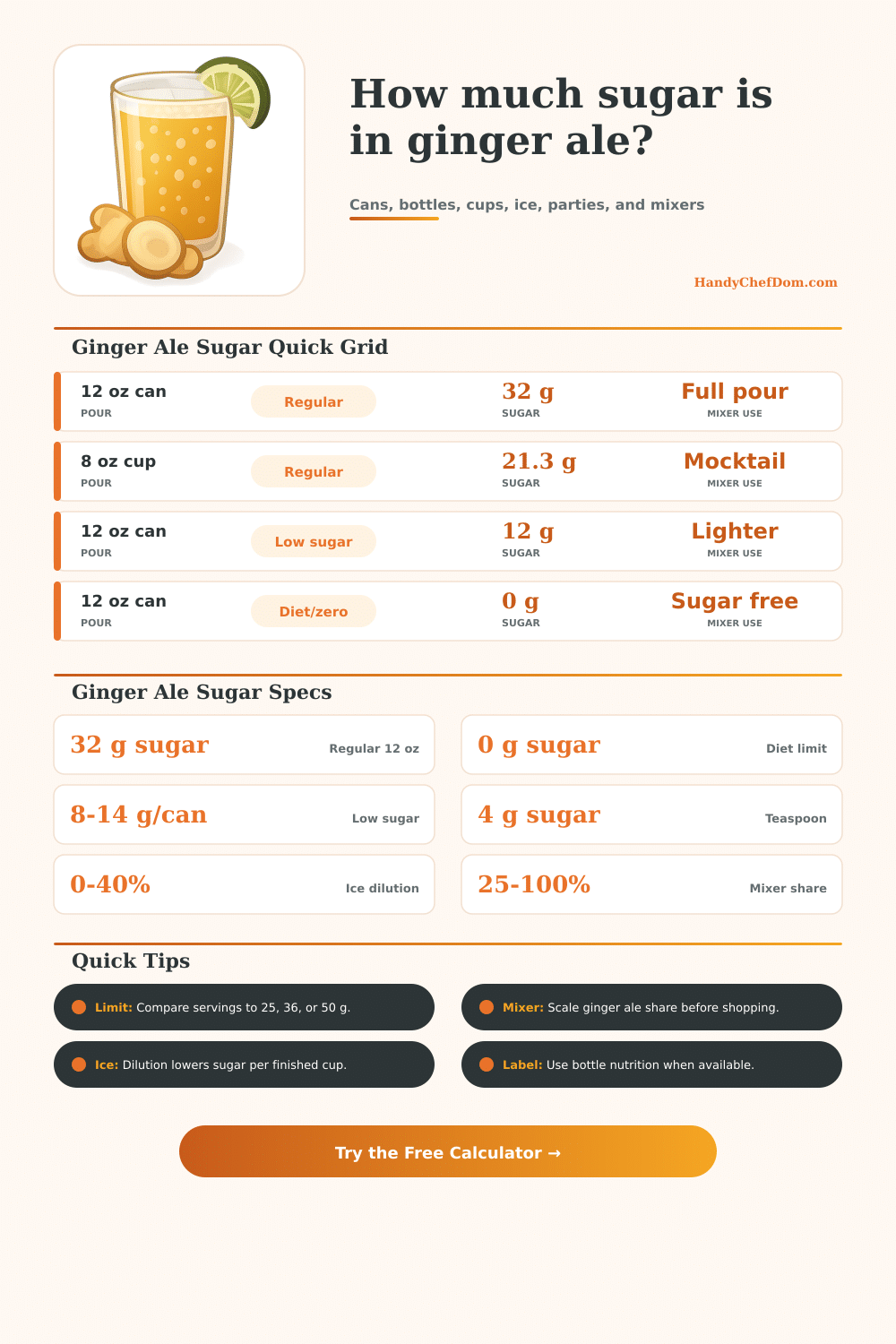
| 8 oz cup pour | 21.3 g / 5.3 tsp | 8 g / 2 tsp | 0 g |
| 10 oz glass bottle | 26.7 g / 6.7 tsp | 10 g / 2.5 tsp | 0 g |
| 12 oz can | 32 g / 8 tsp | 12 g / 3 tsp | 0 g |
| 20 oz bottle | 53.3 g / 13.3 tsp | 20 g / 5 tsp | 0 g |
| 2 liter bottle | 180.3 g / 45.1 tsp | 67.6 g / 16.9 tsp | 0 g |
📏Can, Bottle, Cup, and Party Conversions
| Container | Total volume | 8 oz cups | 4 oz mixer pours |
|---|---|---|---|
| 12 oz can | 12 oz / 355 ml | 1.5 cups | 3 mixer pours |
| 16.9 oz bottle | 16.9 oz / 500 ml | 2.1 cups | 4.2 mixer pours |
| 20 oz bottle | 20 oz / 591 ml | 2.5 cups | 5 mixer pours |
| 1 liter bottle | 33.8 oz / 1 L | 4.2 cups | 8.5 mixer pours |
| 2 liter bottle | 67.6 oz / 2 L | 8.5 cups | 16.9 mixer pours |
| 64 oz pitcher | 64 oz / 1.89 L | 8 cups | 16 mixer pours |
🎯Added Sugar Limit Comparison
| Daily limit | Limit grams | 12 oz regular can | 20 oz regular bottle |
|---|---|---|---|
| AHA women guideline | 25 g | 128% | 213% |
| AHA men guideline | 36 g | 89% | 148% |
| FDA daily value | 50 g | 64% | 107% |
| Personal 30 g target | 30 g | 107% | 178% |
🍸Mixer Use Scaling Table
| Drink plan | Ginger ale share | Ginger ale in 8 oz drink | Regular sugar from ginger ale |
|---|---|---|---|
| Full ginger ale cup | 100% | 8 oz | 21.3 g |
| Mocktail mostly ginger ale | 75% | 6 oz | 16 g |
| Punch or spritz blend | 60% | 4.8 oz | 12.8 g |
| Highball equal mixer share | 50% | 4 oz | 10.7 g |
| Short mixed drink | 35% | 2.8 oz | 7.5 g |
| Splash topper | 25% | 2 oz | 5.3 g |
💡Ginger Ale Sugar Tips
For example: A typical 12-ounce can of ginger ale has about 32 grams of added sugar inside. In other words, that’s eight level teaspoons worth of dissolved granulated sweetness in every pop of soda. Even if you don’t perceive all that sweetness (root ginger is so spicy that it may mask some of it), your body will still process it all the same.
To help you put a number on that behind-the-scenes sweetness, I created a calculator (on this page) to do the math for you. It works regardless of what drinks are coming out of tap, whether they’re mixed mocktails, straight-from-the-can beverages, or a party cooler you’re preparing. The truth is, we are all underestimating our consumption. When sugar comes in liquid form and has volume, one gram goes a lot further then you’d expect.
How Much Sugar Is In Ginger Ale?
A serving sounds reasonable: “I’m just having one.” But then you look at the total reality, where you add eight ounces to a glass filled with ice, and suddenly you’ve got around twenty-one grams of sugar right there. Do that for five other people, times two drink each, and it starts to scale up fast. Looking at the page’s reference tables reveals how many grams of sugar correspond to each size drink. You think a 20-ounce bottle is only slightly bigger than a can? It’s almost twice as sugary as eight ounces poured from a cup. When you’re aiming to keep your added sugar intake down, knowing what separates a two liter bottle from a mini can makes all the difference.
Finally, there’s ice, which complicates things further and is something most laypeople overlook. Pouring a drink over ice dilutes it, since melting ice waters down your beverage. But here’s the key: Sugar molecules aren’t dissapears simply because they’re joined by some water! The amount of sugar in the entire drink isn’t being reduced. Rather, the concentration per sip is greatly reduced. For instance, if I have a big pour over ice that gets diluted forty percent, then every mouthful has less sweetness compared to a neat pour over ice that doesn’t realy get any melty at all. This explains why an iced ginger ale can taste light when sipped slowly but heavier when guzzled cold. You can account for this dilution on the calculator and get a better sense of how many sugar molecules are in each final cup. Rather than merely in the original container.
The other side of the tradeoff involves mixers. For example, when reaching for a ginger ale to sweeten punch bowls and mocktails, most don’t even realize they’re bringing sugar into a beverage that could have been water-based. When ginger ale make up half of your mix, that’s half the sugar you cut out of the base beverage compared to drinking it straight. However, you’re still adding quite a bit of sweetness to something you think of as a mixed drink. With the tool, you can dial down the percentage this represents so you know exactly how much sugar is coming from the ginger ale component versus anything else. That helps you balance flavor while not going overboard on the total amount.
Beyond choosing your label type (regular vs. Diet vs. Low-sugar), you also have to consider the quantity. A standard can of regular ginger ale will provide the familiar sweetness, but will include the complete thirty-two gram punch-in-the-face. Low-sugar sodas tend to clock in around twelve grams, and while that may sound like a decent split-the-difference kind of deal if you’re still craving some sweeter soda, diet/zero-sugar sodas shave down the number closer to zero, but do so without the body you get from sugar. With that in mind, the calculator allow you to compare profiles side-by-side. You can see if each one’s balance of taste, texture, and glycemic impact better suits your needs.
And then there’s another variable: buffer space. For party planners out there; this applies to you too! Parties never go quite as planned. You’ll always end up with a few extra people and some people drinking an extra can or two. Plan to have 10-15 percent extra cans above and beyond your estimate so you don’t run out. But that means you’ve also got to plan for all the sugar that comes from those extra cans floating around in the ice bucket. Buffering for volume logistics is one thing, buffering for overall supply is another.
Finally: Sugar’s not something we’re depriving ourselves of with ginger ale. It’s nothing but awareness. When you measure instead of guess, you know exactly what you’re drinking. It might be part of a celebratory evening in or a night spent curled up on the couch fighting off colds and feeling comfortabley by the spicy fizz. Either way, knowing the numbers behind the bubbles helps us make the choice that fits our lives. Next time you grab a cold can from fridge, just keep in mind those eight teaspoons of sugar are going to add up; and they’ll get counted.