Tofu Calcium Calculator
Estimate calcium, protein, and daily value from tofu serving size, firmness, coagulant type, and drained weight
Reference values use USDA FoodData Central / SR Legacy style records where available; silken, extra-firm, homemade, and low-calcium entries are practical estimates for label comparison.
| Tofu Type | Coagulant Pattern | Calcium / 100 g | Protein / 100 g |
|---|---|---|---|
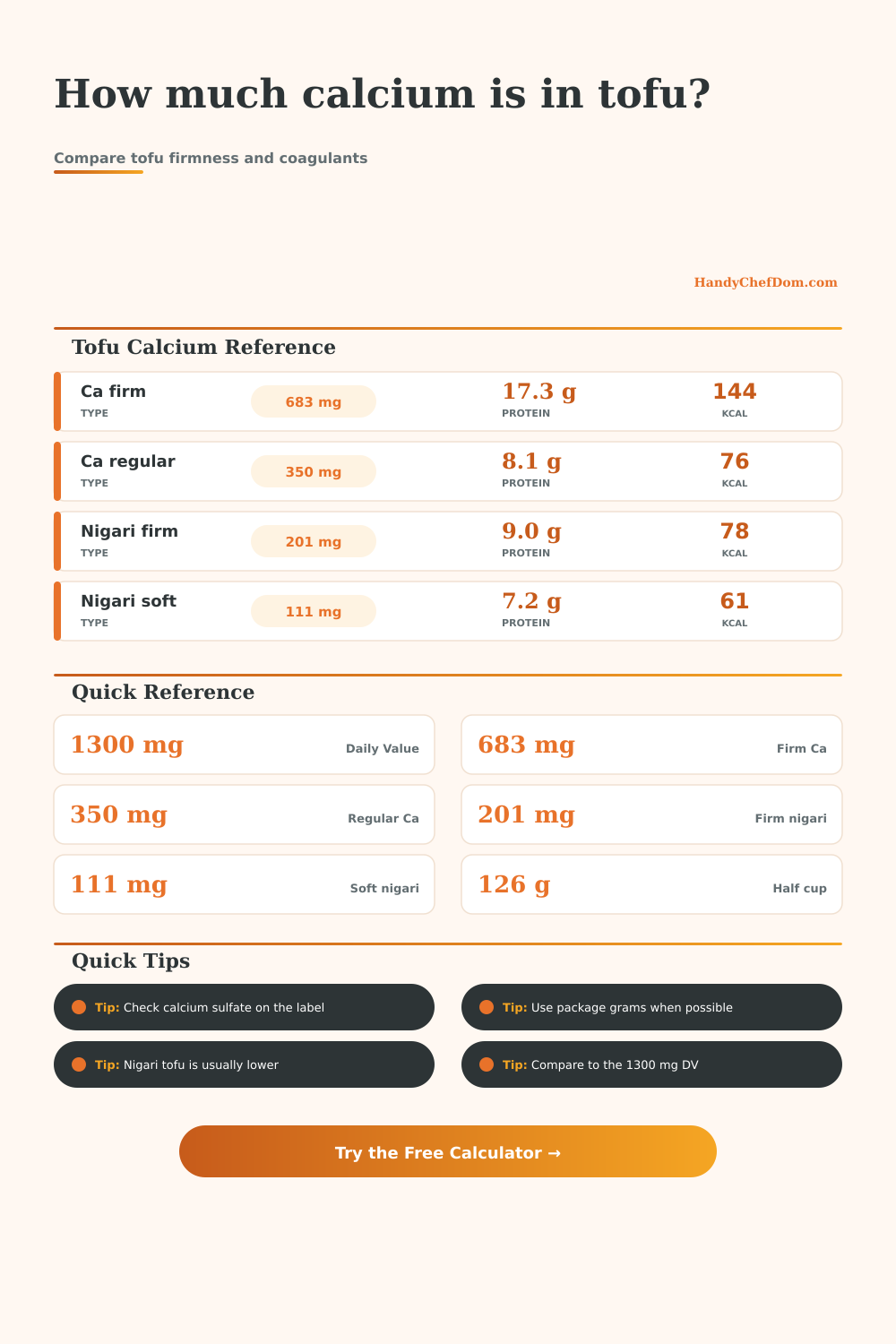
| Firm calcium-set | Calcium sulfate | 683 mg | 17.27 g |
| Extra firm calcium-set | Calcium sulfate | 520 mg | 15.80 g |
| Regular calcium-set | Calcium sulfate | 350 mg | 8.08 g |
| Firm nigari blend | Calcium sulfate + magnesium chloride | 201 mg | 9.04 g |
| Soft nigari blend | Calcium sulfate + magnesium chloride | 111 mg | 7.17 g |
| Silken mixed estimate | Mixed or label-dependent | 120 mg | 6.90 g |
| Serving Format | Typical Weight | Firm Calcium Ca | Firm Nigari Ca |
|---|---|---|---|
| 1/4 cup cubes | 63 g | 430 mg | 127 mg |
| 1/2 cup cubes | 126 g | 861 mg | 253 mg |
| 3 oz portion | 85 g | 581 mg | 171 mg |
| 100 g label check | 100 g | 683 mg | 201 mg |
| 14 oz block | 397 g | 2712 mg | 798 mg |
| 16 oz block | 454 g | 3101 mg | 913 mg |
| Label Clue | Likely Calcium Level | Calculator Choice | Best Input |
|---|---|---|---|
| Calcium sulfate first | High | Firm calcium-set | Use grams |
| Gypsum / calcium sulfate | High to medium | Homemade gypsum | Use batch weight |
| Calcium sulfate + nigari | Medium | Firm nigari blend | Use label if present |
| Magnesium chloride | Lower calcium | Magnesium nigari | Use package label |
| Silken shelf-stable | Variable | Silken mixed estimate | Use package label |
| No coagulant listed | Unknown | Unknown label check | Enter label calcium |
| Target | Firm Calcium Needed | Regular Calcium Needed | Firm Nigari Needed |
|---|---|---|---|
| 250 mg snack | 37 g | 71 g | 124 g |
| 500 mg meal | 73 g | 143 g | 249 g |
| 700 mg meal | 102 g | 200 g | 348 g |
| 1000 mg day | 146 g | 286 g | 498 g |
| 1200 mg day | 176 g | 343 g | 597 g |
| 1300 mg DV | 190 g | 371 g | 647 g |
| Portion | Weight | Calcium | DV % | Protein | Calories | Best Use |
|---|
Tofu is not one-size-fits-all: It’s easy to think tofu must be pretty much the same thing nutritionally. Some kind of uniformly dense soy-protein block, but it’s far more complicated. An equal amount of firm tofu set with gypsum could pack as many minerals as a cup of milk, whereas an equal serving of silken might contain barely more calcium than glass of water.
The reason? Tofu-making techniques affect its nutritional content and its structure. The coagulant that sets the soy milk into tofu contribute as much nutrition as other ingredients, and these coagulants vary greatly. Knowing about this variation goes beyond just portion size when you’re looking at your food for dietary planning or for health reasons like bone health.
Why Tofu Nutrition Changes
What matters most for calcium content is the setting agent on the package label. Gypsum (also known as calcium sulfate) deposit significant amounts of calcium during its setting reaction. Nigari, which is mainly magnesium chloride, sets the curds but contributes minimal calcium. So if you spot a product whose label begins with “calcium sulfate,” it’s a high-calcium variety.
Plug in the coagulant type for your exact brand into the calculator above and let it do the math, no guesswork required about how much mineral content will remain after cooking. It takes the ingredient labels and converts them into something useful. Usable daily values.
The other silent variable here is water content. Soft tofu contains a ton of water (which dilutes all its nutrients per gram). If you drain out this water, it concentrate the nutrients in each gram but lowers the overall weight of what you’re eating. As a result, many folks make this type of tracking error: they weigh their unpressed tofu, then log the numbers from pressed, high-protein tofu, or vice versa.
By letting you indicate how much your tofu block has been squeezed, the tool can adjust the density estimates accordingly. Again, it’s not a big deal, but it matters if you’re targeting very specific levels of something like calcium or protein.
Compare this to, say, a slow-cooked stew versus a quick stir-fry. In the latter case, you probably want a firm (or even extra-firm) tofu that retains its shape when sautéed; in fact, it’s commonly processed with calcium sulfate to help it do so. Here, you get the double benefit of not only mineral density, but also of texture. By contrast, silken tofu will dissolve into whatever you put it in, whether soup or dessert, and while it’ll add some mild flavor and moisture, little if any calcium, except when fortified.
This variation in mineral content follows changes in calorie and protein counts across different tofu textures, as shown clearly in the reference tables. However, most people don’t realize just how much they consume compared to label info. Labels commonly mention “three ounces” per serving, whereas most commercially available blocks is actualy fourteen or sixteen ounces. That means that when you eat half a block at once, it’s really double that amount.
To help bring these figures into perspective, the app provides some common defaults for visualizing the scenario, such as eating a whole portion for yourself, versus cooking up a family-sized stir-fry dish. Or if your own packaging says something else entirely, you can override those default database values so that the information you’re basing estimates on matches whatever’s in your fridge.
When you plan meals with tofu, remember that it’s no one-size-fits-all superfood. You want to make sure you’re buying tofu that prioritizes nutrient density, not just cost and consistency. The best indicator of this is whether it contains gypsum or calcium sulfate. If so, you’re getting some of these minerals; otherwise, you may be consuming low-calcium tofu but thinking you’re making a meaningful contribution to your daily needs. Read the fine print. Don’t trust what’s on the front of the package.
All in all, this becomes a more effective way to plan meals once you stop thinking of tofu as a constant. Do you want those thousand milligrams they recommend? Or do you have an older body that needs even more, and if so, how much more? Knowing the payload means knowing what kind of block to buy. The calculator will crunch the numbers according to your selection.
Ultimately, it is about building the habit of accounting for lost water and noting coagulants so you know you are getting it right over time. You should of used guesswork gives way to informed feeding. What’s really on your plate?