Powdered Sugar Cups to Pounds Converter
Convert powdered sugar cups into pounds, ounces, and grams with sifted versus unsifted density, package planning, frosting yield, and dusting buffer included.
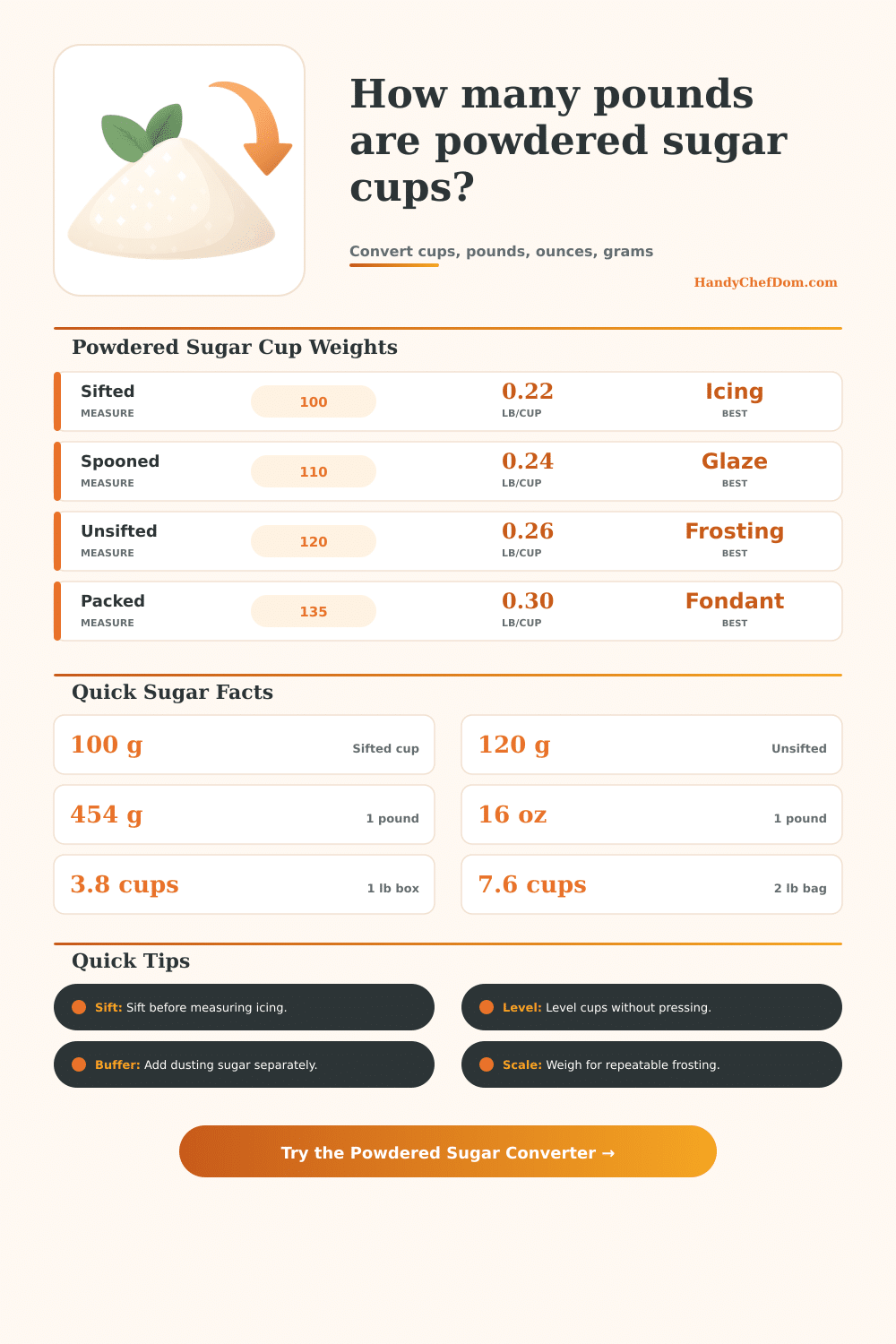
Density rule: this converter uses about 120 g per cup for unsifted powdered sugar and about 100 g per cup for sifted powdered sugar. Choose a style that matches how the cup is filled.
| Powdered Sugar Style | Grams Per Cup | Ounces Per Cup | Pounds Per Cup |
|---|---|---|---|
| Sifted before measuring | 100 g | 3.53 oz | 0.220 lb |
| Spooned and leveled | 110 g | 3.88 oz | 0.243 lb |
| Unsifted from bag, leveled | 120 g | 4.23 oz | 0.265 lb |
| Settled bag cup | 125 g | 4.41 oz | 0.276 lb |
| Pressed or packed cup | 135 g | 4.76 oz | 0.298 lb |
| Package Size | Weight | Unsifted Cups | Sifted Cups |
|---|---|---|---|
| Small box | 1 lb | 3.78 cups | 4.54 cups |
| Standard bag | 2 lb | 7.56 cups | 9.07 cups |
| Large bag | 4 lb | 15.12 cups | 18.14 cups |
| Bulk bakery bag | 10 lb | 37.80 cups | 45.36 cups |
| Half-pound leftover | 0.5 lb | 1.89 cups | 2.27 cups |
| Frosting Use | Sugar Cups | Approx Yield | Typical Coverage |
|---|---|---|---|
| American buttercream | 4 cups | 3 cups frosting | 24 cupcakes |
| Cream cheese frosting | 3 cups | 3 cups frosting | 18 cupcakes |
| Royal icing | 4 cups | 2.75 cups icing | 36 cookies |
| Pourable glaze | 2 cups | 1.5 cups glaze | 1 bundt cake |
| Macaron filling | 2 cups | 1.4 cups filling | 40 shells |
| Crumb coat | 3 cups | 2.4 cups frosting | 8 inch layer |
| Recipe Cups | Unsifted Pounds | Sifted Pounds | Best Package |
|---|---|---|---|
| 1 cup | 0.26 lb | 0.22 lb | Pantry leftover |
| 2 cups | 0.53 lb | 0.44 lb | 1 lb box |
| 4 cups | 1.06 lb | 0.88 lb | 2 lb bag |
| 8 cups | 2.12 lb | 1.76 lb | 4 lb bag |
| 12 cups | 3.17 lb | 2.65 lb | 4 lb bag |
| 24 cups | 6.35 lb | 5.29 lb | 10 lb bag |
For home bakers, weight is law; volume is only a suggestion. Depending on your humidity and how you scoop or pack flour, your cup of flour might not match someone else’s. And then there is powdered sugar: the extreme version of this issue, because it are made to be full of air. Unsifted powder (a one-pound box) can result in almost four cups while sifting that same pound ahead of time result in closer to four and a half cups. It does not look like much on paper, but it is enough to make sure your buttercream isn’t gritty or that you have just the right amount of sweetness in your royal icing.
On this page, the converter tool do the work for you by allowing you to choose between sifted, unsifted, spooned, packed sugar, etc. The different choices alter density of grams per cup quite a bit, which in turn makes the calculated weight shift. Knowing how much difference density makes will also prevent recipe failures before you even begin.
Why Weight Is Better Than Cups for Baking
Powdered sugar come packed together in bag. If you scoop it straight from the bag, you are using more dense sugar than if you had sifted it into a bowl and poured it from there. The calculator accounts for this by providing a range of density options. If you know that your sugar hasn’t been sifted, select the unsifted option (about 120 grams/cup), whereas if your sugar has been sifted, select the sifted option (about 100 grams/cup). Selecting the wrong one mean your ingredients won’t be in line with recipe’s assumptions, which results in an incorrect texture.
Pantry-stored sugar defaults to unsifted state, so most folks pick that setting as their default. However, recipes calling for light glazes typically call for the sugar to have been sifted, assuming its lighter weight. Knowing this ensures that you don’t end up with a frosting that’s too sweet or too weak to support itself.
For me, this is especially helpful when I’m planning my inventory (or lack thereof). For example: I know I’ll need four cups of sugar for a batch of cupcakes. But how many 2-pound bag is that? Enter the converter! With this tool, just enter the number of batches you are making and the type of package. It tells you exactly how much total product will be required.
It also includes some wiggle room to account for any “lost” sugar while sieving or some left over for sprinkling on cakes. If you bake frequently or cater an event, this feature is invaluable. No more having to rush to the grocery store in the middle of the night because you ran out of something! Instead, just plug in the number of batches you plan on making and it tells you exactly how much of what you should stock up on. You don’t even have to find a conversion chart elsewhere. There are tables right there for you to quickly check for the equivalent.
There’s another wrinkle in scaling recipes: double a recipe, yes, but double all ingredients including the sugar? And do I need to adjust for increased surface area while I’m dusting things? The calculator let you choose whether to add a multiplier for batch scaling. It also has an input for “additional tbsp.” If the recipe specifies, say, 3/4 cup plus a few tablespoons, you enter those extra tablespoons here. The final weight calculation will be adjusted to match, reflecting the real world instead of an idealized moddern mathematical model.
It even lets you select a custom buffer percentage to account for your own habits. Do you always sift vigorously, or do you err on the side of cleaning bowls more thoroughy? Knowing what you’re dealing with, in this case, powdered sugar, matters when baking. Powdered sugar isn’t just regular granulated sugar crushed into smaller pieces; it’s also got cornstarch added as a stabilizer so that it doesn’t clump. This changes its weight and its flow rate.
Stop guessing by switching from volume measurements to precise weights. This lets you know exactly how many pounds and grams of sugar are in each cup, whether you are making an elaborate multi-layer wedding cake or a simple muffin glaze. You should of stopped guessing before. That tiny space between how much sugar you think you have versus how much you actualy weighed is often what makes the difference between a perfect batch and one that’s a total bust.