🌽 Sour Cream in Corn Casserole Calculator
Balance sour cream cups, grams, corn cans, pan depth, muffin mix, eggs, butter, cheese, moisture, and servings for corn casserole.
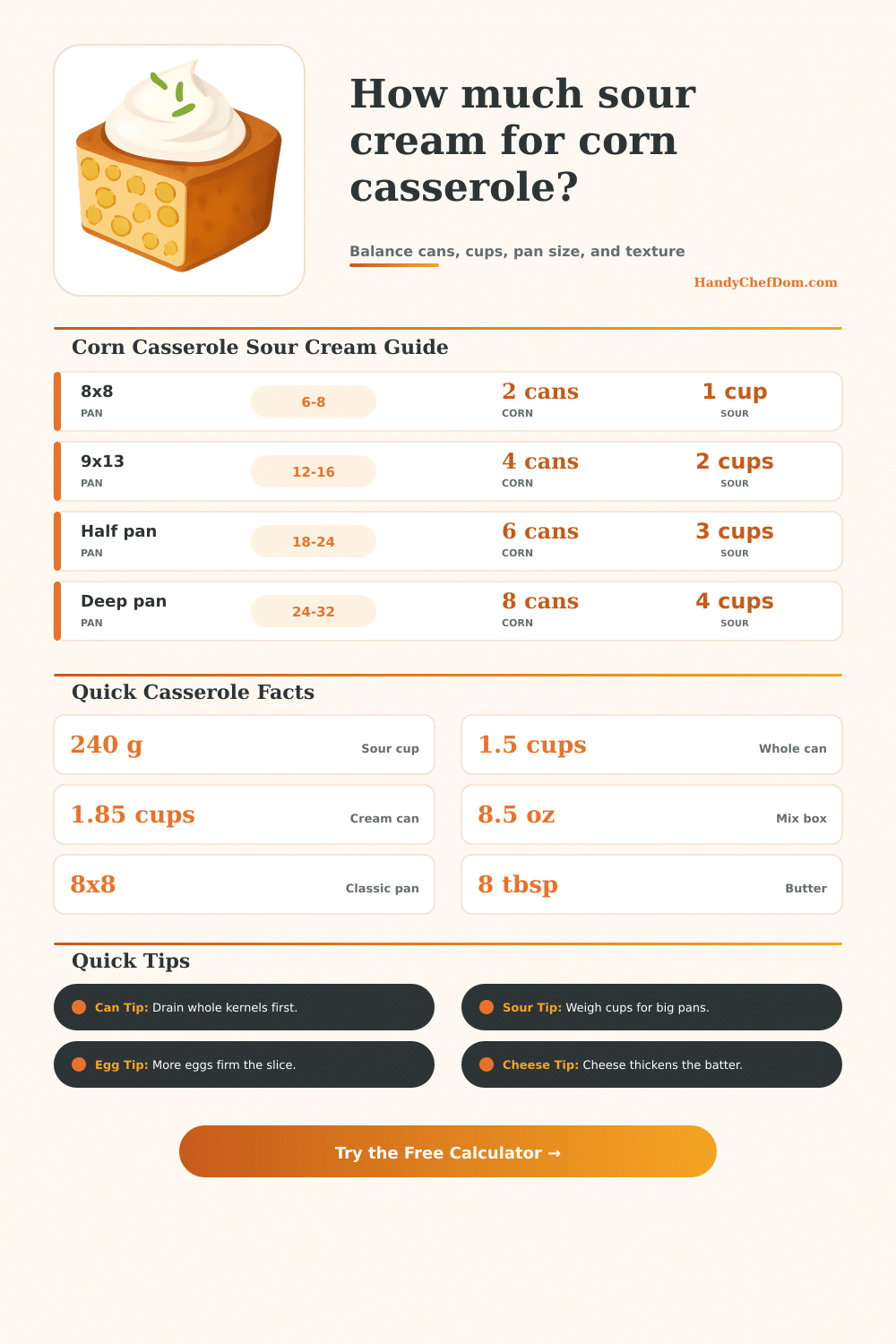
A classic corn casserole often starts with 1 drained whole-kernel can, 1 creamed corn can, 1 cup sour cream, 1 corn muffin mix box, butter, and eggs for an 8x8 or 9x9 pan. This calculator scales that ratio by corn volume, pan area, mix style, and desired moisture.
Classic Corn Casserole Scaling
| Pan size | Servings | Corn cans | Sour cream |
|---|---|---|---|
| 8x8 or 9x9 | 6 to 8 | 1 whole + 1 creamed | 1 cup / 240 g |
| 11x7 | 8 to 10 | 2.5 to 3 cans | 1.25 to 1.5 cups |
| 9x13 | 12 to 16 | 4 cans | 2 cups / 480 g |
| Half steam pan | 18 to 24 | 6 cans | 3 cups / 720 g |
| Deep 9x13 | 16 to 20 | 5 cans | 2.5 cups / 600 g |
| Catering batch | 24 to 32 | 8 cans | 4 cups / 960 g |
Corn and Dairy Conversions
| Ingredient | Common unit | Cup estimate | Metric estimate |
|---|---|---|---|
| Whole-kernel corn, drained | 15.25 oz can | 1.50 cups | 250 g kernels |
| Creamed corn | 14.75 oz can | 1.85 cups | 418 g can |
| Sour cream | 1 cup | 1.00 cup | 240 g |
| Corn muffin mix | 8.5 oz box | 1.50 cups | 241 g dry |
| Melted butter | 8 tbsp | 0.50 cup | 113 g |
| Shredded cheese | 1 cup | 1.00 cup | 113 g |
Texture Targets
| Target | Sour cream ratio | Egg direction | Depth note |
|---|---|---|---|
| Sliceable | 0.42 cup per corn pair | Add egg support | 1.25 to 1.55 inches |
| Classic creamy | 0.50 cup per corn pair | Balanced eggs | 1.45 to 1.90 inches |
| Spoonable soft | 0.58 cup per corn pair | Moderate eggs | 1.60 to 2.10 inches |
| Extra custardy | 0.66 cup per corn pair | More egg helps set | 1.75 to 2.35 inches |
| Extra cheesy | Reduce 0.05 cup | Keep eggs steady | Watch center depth |
| No mix bake | Add 0.10 cup | Eggs carry set | Keep shallower |
Mix Type Absorption Guide
| Mix type | Dry cups | Moisture pull | Calculator effect |
|---|---|---|---|
| 8.5 oz corn muffin mix | 1.5 cups | Standard | Baseline sour cream |
| 15 oz cornbread pouch | 2.6 cups | High | Adds sour cream need |
| Scratch dry blend | Entered cups | Medium | Uses dry cup input |
| Spoonbread custard | 1.2 cups | Lower | More egg emphasis |
| Gluten-free mix | 1.6 cups | High | Protects moisture |
| No packaged mix | 0 cups | Very low | Flags softer set |
Whether it’s creamy and sliceable or ends up dry at the edges or too soft in the middle, that’s all about the sour cream in corn casserole. Typically, recipes will begins from a starting point: One cup of sour cream for every couple of cans of corn. But then again, what if you change toppings? What if you change the pan size? Or maybe it is the kind of mix you’re making? That’s where the calculator kicks in. It does the math based off how much corn you put into the pan, and so on. You won’t have to guess anymore which is what usually happens when you double or halve a recipe from your family cookbook.
But what’s being measured as inputs? How wide and long your pan are defines its surface area. The bigger the pan, the more batter spreads thin. Its target depth also matter. Anything deeper than an inch or two will take longer to set, with the possibility of drying out on top before it’s finished in the middle.
How to Fix Your Corn Casserole
If you’re using corn muffin mix instead of the kind from a box, or gluten-free instead of normal, those different blends can absorbs liquid differently; this adjustment moves the recommended sour cream up or down accordingly. Similarly, cheese work the opposite way. Adding solids to thicken the batter means you need less sour cream, so adding a whole cup or more causes the target sour cream level to decrease slightly.
Your personal preference is most apparent in your moisture target. For a custard-y, spoonable version, go heavier on the sour cream and really pack in the filling so there’s enough for every spoonful to remain soft. But if you’re aiming for something slice-able, go lighter on the sour cream (and perhaps add a little more egg) to ensure squares stays intact on the plate. The calculator takes care of translating that choice into a specific number instead of having to guess.
Sour cream is typically where people goes wrong: they think of it as a non-variable ingredient rather than something that might be too much or not enough. They squeeze all the juice out of their corn but then don’t account for all the juice that the mix will pull out of the batter. Or they put on too-thick of a cheese layer and don’t account for the fact that that’s going to slow down the evaporation process and maybe even lead to an under-set middle.
The thing is, the calculator checks that second issue. It compares actual versus ideal sour cream amounts and also compares depth of your batter with what you said it should look like. This allows you to know if you need to back off on the topping, or add a touch more sour cream (or perhaps alter the eggs before baking).
After learning the relationship, you’ll use this tool less to find one magic number and more to match the result to the moment. Firmer squares goes better on a holiday table where they hold up during transport; soft spoonable texture makes sense on a weeknight dinner. And if you tune the ratios of what’s in your actual hand-mix to fit what you happen to have on hand, you can gets the same results from the same base ingredients.
You should of used this tool earlier. The mix will dissapears if it is too wet. It feels more naturaly than other tools. Actually, most people find the process comfortabley easy. One could say the moddern way of baking is different than before.