Cooking Temperature Conversion Calculator
Convert cooking temperatures between Fahrenheit, Celsius, and Kelvin, then adjust oven settings for altitude, calibration, and method with this calculator.
Start with a source temperature, then convert it to the scale you need and tune the final setting for your oven and cooking style.
| F | C | K | Use |
|---|---|---|---|
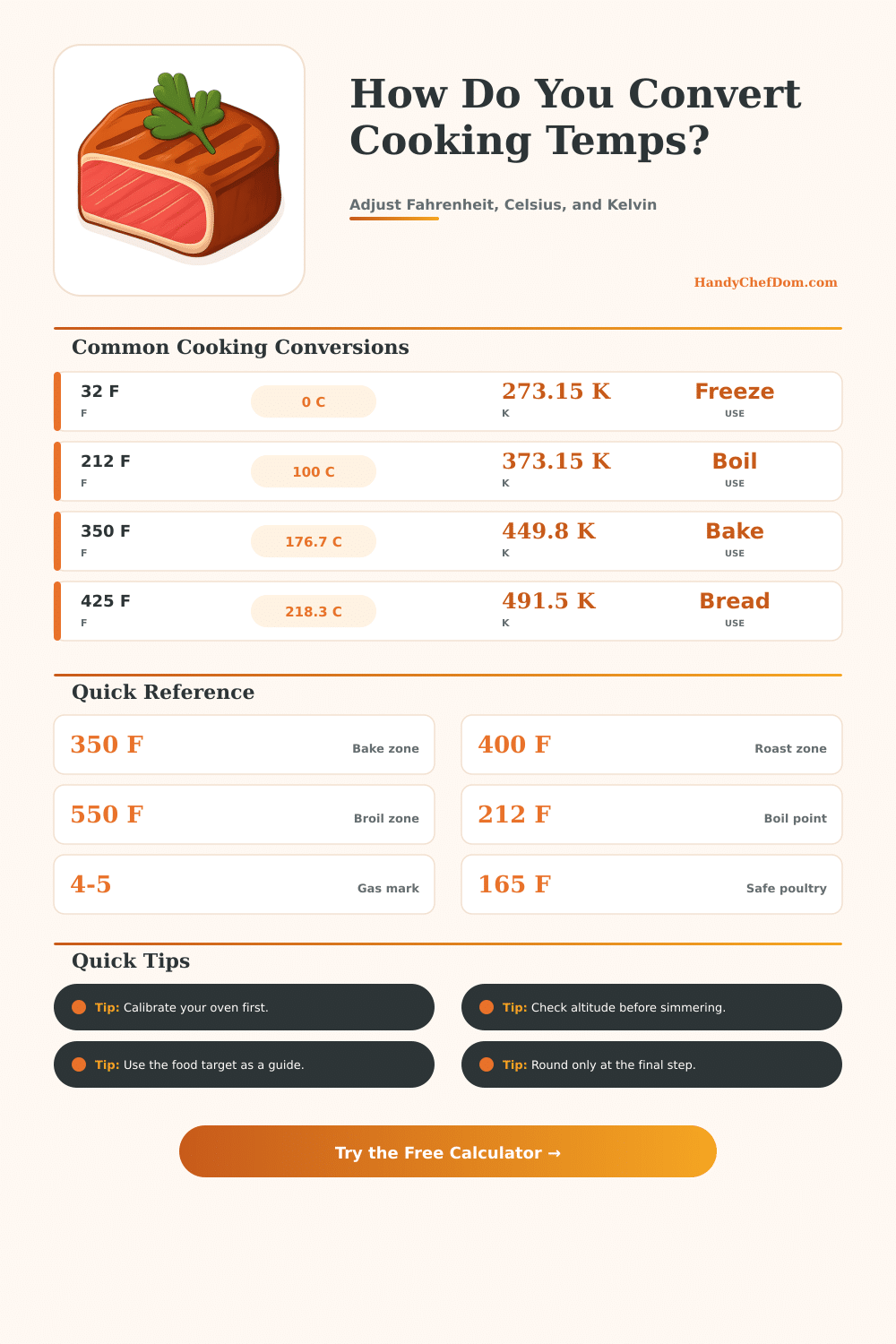
| 32 F | 0 C | 273.15 K | Freeze |
| 212 F | 100 C | 373.15 K | Boil |
| 350 F | 176.7 C | 449.8 K | Bakery |
| 375 F | 190.6 C | 463.8 K | Roast |
| 425 F | 218.3 C | 491.5 K | Bread |
| 500 F | 260 C | 533.1 K | Pizza |
| Method | Range F | Range C | Note |
|---|---|---|---|
| Simmer | 180-205 | 82-96 | Near boil |
| Bake | 325-375 | 163-190 | Even heat |
| Roast | 375-450 | 190-232 | Dry heat |
| Broil | 500-550 | 260-288 | Top heat |
| Candy | 285-310 | 140-154 | Sugar stage |
| Sous vide | 122-185 | 50-85 | Water bath |
| Food | Target F | Target C | Note |
|---|---|---|---|
| Chicken | 165 F | 74 C | Juices run clear |
| Turkey | 165 F | 74 C | Breast and thigh |
| Beef MR | 135 F | 57 C | Rest after cooking |
| Pork | 145 F | 63 C | Small pink ok |
| Bread | 190 F | 88 C | Internal set |
| Custard | 170 F | 77 C | Gentle set |
| Gas | F | C | Use |
|---|---|---|---|
| 1 | 275 F | 135 C | Very gentle |
| 2 | 300 F | 150 C | Slow bake |
| 3 | 325 F | 165 C | General bake |
| 4 | 350 F | 177 C | Standard bake |
| 5 | 375 F | 190 C | Roast |
| 6 | 400 F | 205 C | Hot roast |
Temperature conversion are necessary to follow recipes that use different temperature scales. Some recipes call for use of the Fahrenheit scale to denote cooking temperatures while others use the Celsius scale. In cases where the recipe use the Celsius scale and the oven displays temperatures in Fahrenheit, the cook will have to convert the Celsius temperature to an appropriate Fahrenheit temperature.
There are different types of temperature conversion tools available that will allow you to input the Celsius temperature and recieve correct Fahrenheit temperature. Using these types of tools will make it easier for cooks to follow recipes because it will eliminate the need for them to use the mathematical formulas to perform the conversion themselves. There are several different temperature scales in existence, most of which have historical reasons for there existence.
How to Convert Temperatures for Cooking
However, the main difference between scales like the Fahrenheit and Celsius is in the way in which each scale measure heat. For instance, kitchens in America mostly use the Fahrenheit scale while the Celsius scale is used much more wide throughout the rest of the world. Fahrenheit scales use whole numbers to denote temperatures while Celsius scales often require the use of decimals in their measurements.
It is important to be careful when performing a temperature conversion from one scale to another. If the temperature is too high for the food that is being cooked, the food can burn. However, if the temperature is too low, the food may not cook proper.
One of the factors that can affect cooking temperatures is the altitude at which the food is being prepared. At high altitudes, the boiling point of water change. At higher altitudes, there is lower air pressure which cause the boiling point of water to be lower.
For example, cooking at altitudes above 3,000 feet require that the cook take into account the change of the boiling point of water at these altitudes. If the cook does not account for the boiling point of water at these altitudes, food items like sugar syrup will not reach the correct boiling stage and bread will not rise correctly. Using a temperature conversion tool allow cooks to account for these differences in altitude as the tool can calculate the correct cooking temperature based off the altitude of the kitchen.
Cooking methods require different cooking temperatures. For example, baking ranges from 325 to 375 degree Fahrenheit while roasting requires temperatures between 375 and 450 degree Fahrenheit. Broiling requires very high temperatures, typically above 500 degrees Fahrenheit.
Using the appropriate cooking method ensure that the food will have the correct texture after cooking. For instance, a temperature that is perfect for baking a cake may be too high than roasting a chicken. Internal temperatures of the food must reach certain levels to ensure the food is safe to eat.
For instance, you should use a thermometer to ensure that meat has reached an internal temperature that has killed any bacteria that may be within the meat. Chicken should reach an internal temperature of 165 degree Fahrenheit, as reaching this temperature will ensure the chicken isnt undercooked. For beef, an internal temperature of 135 degree Fahrenheit will results in a medium-rare steak.
For pork, an internal temperature of 145 degree Fahrenheit is the target temperature to ensure the meat is cooked proper. It is important to understand the difference between the internal temperature of the food and the oven temperature. The oven temperature will measure the heat of the appliance, while the internal temperature of the food will gauge the heat of the food itself.
In order to ensure that an oven reach the correct temperature, someone must perform oven calibration. The temperature of ovens can often differ from the temperatures that are displayed on the ovens. To even out these difference, offsets can be used.
Offsets are numbers that are either added to or subtracted from the displayed temperature of the oven. You can find offsets by using a separate thermometer to measure the actual temperature of the oven. Using these offsets will ensure that food is cooked to the temperature that the recipe intended.
Accuracy in the conversion of temperatures is important, as inaccuracies can lead to cooking errors. You can avoid rounding numbers until the very end of the cooking process in order to ensure that the temperature conversion are as accurate as possible. It is also important to preheat the oven to ensure the temperature is maintained during the cooking process.
If the oven is not preheated prior to cooking, the temperature will fluctuate within the oven which may have an impact on the cooking of the food. You should of preheated the oven to avoid this.