🥛 Protein in Cottage Cheese Calculator
Estimate cottage cheese protein by cups or grams, fat level, curd style, label override, recipe use, meal count, and target protein.
Use the brand override when your tub label lists a different protein number. Leave it at 0 to use the calculator's cottage cheese style data.
| Fat Level | Protein per 1/2 Cup | Calories | Fat | Carbs |
|---|---|---|---|---|
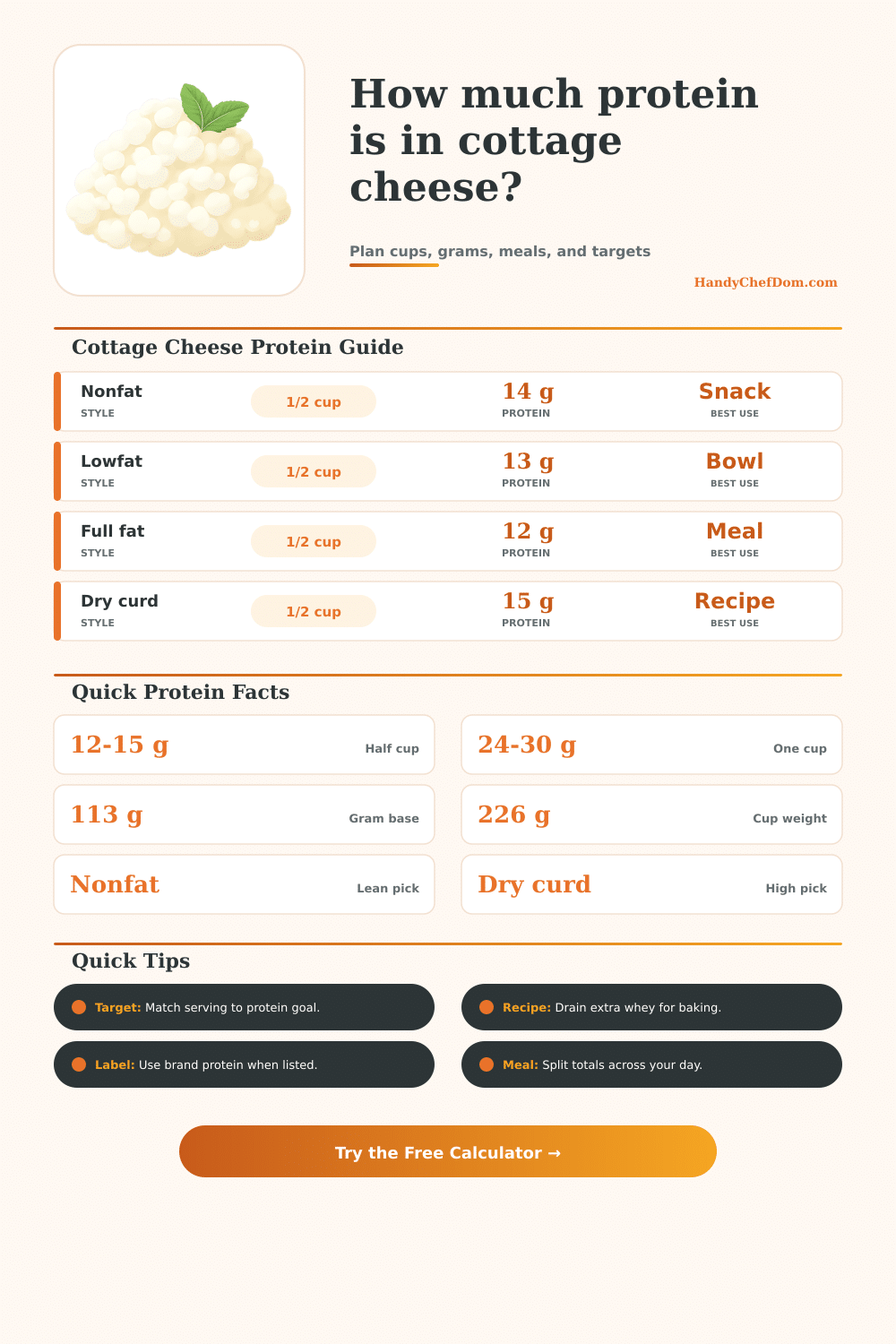
| Nonfat cottage cheese | 14 g | 80 | 0 g | 6 g |
| Lowfat 1 percent cottage cheese | 13 g | 90 | 1 g | 6 g |
| Reduced fat 2 percent cottage cheese | 13 g | 100 | 2.5 g | 5 g |
| Full fat 4 percent cottage cheese | 12 g | 110 | 5 g | 5 g |
| Extra creamy cottage cheese | 11 g | 130 | 7 g | 5 g |
| Dry curd cottage cheese | 15 g | 90 | 0.5 g | 3 g |
| Measure | Approx Weight | Nonfat Protein | 2 Percent Protein | Full Fat Protein |
|---|---|---|---|---|
| 1/4 cup | 57 g | 7 g | 6.5 g | 6 g |
| 1/3 cup | 75 g | 9.3 g | 8.6 g | 8 g |
| 1/2 cup | 113 g | 14 g | 13 g | 12 g |
| 2/3 cup | 151 g | 18.7 g | 17.3 g | 16 g |
| 3/4 cup | 170 g | 21 g | 19.5 g | 18 g |
| 1 cup | 226 g | 28 g | 26 g | 24 g |
| Recipe Use | Typical Portion | Texture Note | Protein Planning Note |
|---|---|---|---|
| Spoonable snack cup | 1/2 cup | Regular moisture | Count the label serving directly. |
| Breakfast bowl topping | 1/2 to 3/4 cup | Small curd blends easily | Add fruit or oats after protein math. |
| Post-workout bowl | 3/4 to 1 cup | Thicker curd feels more filling | Compare against the per meal target. |
| Pancake or muffin batter | 1 to 2 cups | Blended curd disperses better | Divide protein across finished servings. |
| Lasagna or casserole layer | 1 to 3 cups | Large curd holds texture | Use portion count for per serving protein. |
| Dip or spread | 1 to 2 cups | Whipped curd is smooth | Add mix-ins separately if protein-rich. |
| Curd Style | Weight Shift | Protein Shift | Best Calculator Use |
|---|---|---|---|
| Small curd | Standard | No change | Use for most tubs and snack bowls. |
| Large curd | Slightly lighter per cup | 2 percent lower | Useful when curds are loose and wet. |
| Whipped or blended | Airy per cup | 5 percent lower by cup | Best when measuring by grams is unavailable. |
| Dry and well-drained | Denser per cup | 8 percent higher | Use for recipes after draining whey. |
| Creamed curd | More dressing | 6 percent lower | Good for rich tubs with visible cream. |
| Lactose-free style | Standard | No change | Use label override if brand differs. |
Cottage cheese are a food that contains protein, and many peoples often use it as a source of protein for there diets. While cottage cheese are not exactly yogurt, it is also not exactly cheese. However, cottage cheese can contain differents amounts of protein depending on the type of cottage cheese that is being use.
For instance, nonfat cottage cheese typically contains more protein per weight of cottage cheese than full-fat cottage cheese does because the nonfat cottage cheese have had the fat removed from the product. Additionally, full-fat cottage cheese will typically contain less protein per spoonful of cottage cheese than dry curd cottage cheese because the fat in the full-fat cottage cheese dilute the protein in the product. Dry curd cottage cheese also typically contains more protein per weight of product than wet cottage cheese do because dry curd cottage cheese has very little moisture in the product.
How to Calculate Protein in Cottage Cheese
Thus, because the density of cottage cheese change depending upon the fat and moisture content of the product, the amount of protein that is in a serving of cottage cheese can change. In order to determine the amount of protein that is in an serving of cottage cheese, it is possible to use a calculator to determine the exact amount of protein. The generic amount of protein that may be displayed on the product label for a tub of cottage cheese may not be the same than the amount of protein that will be in a serving of cottage cheese.
By entering the specific amount of protein into the calculator, as well as the serving size of the cottage cheese, the calculator will provide accurate estimate of the protein content of the cottage cheese that you intend to eat. The way that you prepare the cottage cheese prior to consume it will also change the amount of protein that is contained in the final meal that you eat. If you drain the liquid from the cottage cheese, you will create a product that is more concentrate and contains more protein per serving.
However, if you add liquid to the cottage cheese prior to consuming it, the cottage cheese will contain less protein per serving. Additionally, if you use cottage cheese in a recipe, such as cottage cheese pancake or lasagna, the amount of protein that is contained in one serving of the recipe will be less than the amount of protein that is contained in the original cottage cheese. However, the calculator allows you to account for these changes so that the calculator still accurately represented the protein content of your meal.
Many people dont consume cottage cheese by itself. Instead, they often add other ingredient to their cottage cheese to enhance the flavor of the dairy product. Many recipes for cottage cheese include the addition of seeds to the cottage cheese, yogurt to the cottage cheese, or even protein powder to the cottage cheese.
By adding these ingredient to the cottage cheese, the amount of protein that is consumed will be higher than if the cottage cheese was consumed by itself. By using the add-in field for the recipe and protein calculator, the calculator can account for the amount of protein in these added ingredients so that the total amount of protein in the meal is accurately represented. This prevents anyone from undercounting the amount of protein that is in the meal that they consume.
It is also important to track the amount of protein that is contained in the cottage cheese that you eat each day in order to ensure that you are meeting your protein intake goal. For instance, if you eat cottage cheese for both breakfast and lunch, you will need to add the amount of protein from the cottage cheese that you ate for breakfast to the amount of protein from the lunchtime cottage cheese. The calculator can easily help you to calculate this amount.
You can use the calculator to determine if the total amount of protein from your cottage cheese consumption for that day meet your protein target, or if you need to eat more or less cottage cheese than you do throughout the day. Thus, using this calculator remove the need for mental math to calculate the total amount of protein that you consume from cottage cheese throughout the day.