🧺 Baking Soda for Laundry Calculator
Estimate a practical baking soda dose for laundry by load size, washer type, odor, soil, water hardness, detergent boost, scoop size, and unit system.
Use this as a laundry additive estimate, not a replacement for garment care labels or detergent directions. Baking soda is mild, but dosage still changes with water level and fabric type.
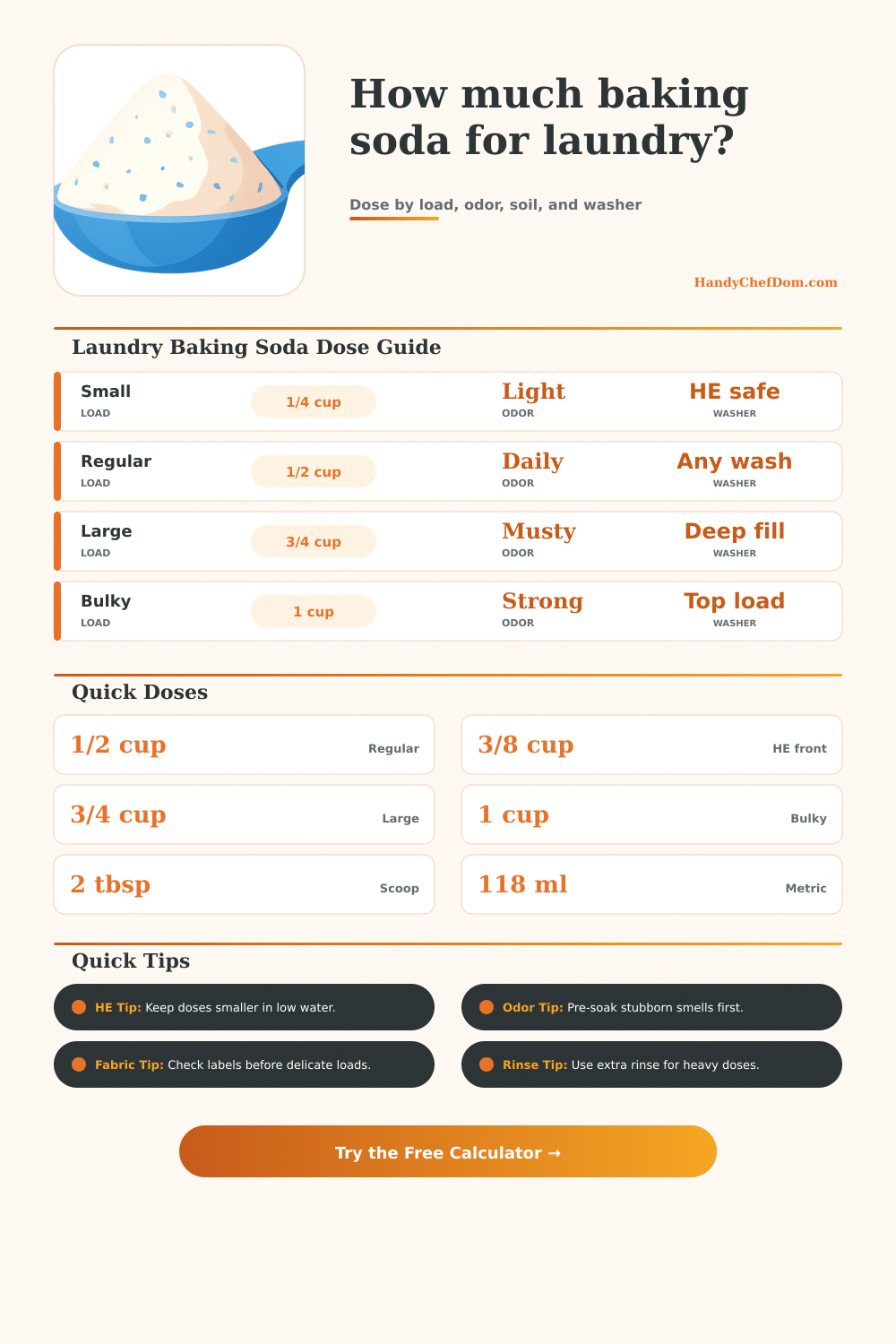
| Load type | Typical weight | Starting dose | Best use |
|---|---|---|---|
| Small sink or mini load | 2-5 lb / 1-2 kg | 1 to 4 tbsp | Travel socks, hand wash, quick refresh |
| Small washer load | 5-8 lb / 2-4 kg | 1/4 cup | Light shirts, pajamas, school clothes |
| Regular washer load | 8-12 lb / 4-5.5 kg | 1/2 cup | Mixed household laundry with normal odor |
| Large washer load | 12-16 lb / 5.5-7 kg | 2/3 to 3/4 cup | Towels, bedding, large family wash |
| Bulky deep-fill load | 16-22 lb / 7-10 kg | 3/4 to 1 cup | Blankets, pet bedding, heavy cottons |
| Pre-soak tub | Variable | 1/2 cup per tub | Odor loosening before a full rinse cycle |
| Washer type | Dose behavior | Practical cap | Why it changes |
|---|---|---|---|
| HE front loader | Use about 80% of a standard dose | About 3/4 cup | Low water can leave residue if overloaded |
| HE top loader | Use about 90% of a standard dose | About 7/8 cup | More water than front load, still concentrated |
| Standard top loader | Use the regular calculated dose | About 1 1/4 cups | Normal fill dilutes baking soda well |
| Deep-fill top loader | Can use a little more for bulky loads | About 1 1/2 cups | High water volume handles bigger doses |
| Sink or bucket wash | Use a much smaller dose | About 1/3 cup | Hand rinsing is harder than machine rinsing |
| Pre-soak before wash | Use moderate dose, then rinse fully | About 1 cup | Odor treatment works before detergent wash |
| Soil or odor trigger | Adjustment | Soak guide | Helpful note |
|---|---|---|---|
| Light wear, no odor | Reduce slightly | 0 minutes | Often needs only a small freshness dose |
| Everyday mixed laundry | Baseline | 0-10 minutes | Good target for weekly household loads |
| Kitchen towels and food splashes | Add modest boost | 10-20 minutes | Pairs well with normal detergent dose |
| Gym sweat or body oil | Add stronger boost | 20-30 minutes | Use extra rinse for tight synthetic fabrics |
| Musty towels or bedding | Add odor boost | 30-45 minutes | Do not overload the washer drum |
| Pet bedding or smoke smell | Use high odor setting | 45-60 minutes | Wash separately from delicate garments |
| Water and rinse factor | Calculator effect | When to choose it | Rinse note |
|---|---|---|---|
| Soft water | Small reduction | Water feels slick and detergent foams easily | Normal rinse usually works |
| Moderately hard water | Small boost | Average tap water with some minerals | Normal rinse for standard doses |
| Hard water | Noticeable boost | Mineral marks, dull towels, low suds | Extra rinse helps heavy loads |
| Very hard water | Strongest boost | Stiff fabrics or frequent mineral buildup | Avoid short rinse cycles |
| Short cycle | Caps the dose lower | Quick refresh loads with limited rinse time | Use less to avoid powder residue |
| Pre-soak cycle | Allows odor treatment | Musty towels, pet blankets, smoke smells | Follow with a complete rinse |
Baking soda is a substance that you can add to your laundry to help with the clean of your clothes. Baking soda neutralize the odors in the laundry and helps to manage the hardness of the waters in the washing machine. People use baking soda when adding laundry detergent because the detergent may not be able to fully remove the odor from the clothes.
Furthermore, people use baking soda in there laundry because hard water may make the clothes stiffly. Baking soda can be used in the laundry in amounts that are appropriate for a load of laundry. Using too much baking soda, however, can lead to residue on the clothes and inside of the washing machine.
How Much Baking Soda to Use in Laundry
To calculate the amount of baking soda that is needed for the laundry, the calculator consider several factors. These factors include the weight of the laundry, the type of washing machine that you will use, the soil of the clothing, the strength of the odors in the laundry, the hardness of the water that is to be used in the machines, and the size of the scoop that will be used for the baking soda. The weight of the laundry impact the amount of water that will be used to clean the clothes.
The type of washing machine will indicate how much water will be needed for the load of laundry. Hard water can contain minerals that make the detergent less effective, so you will use more baking soda to react to this water. For most load, one half cup of baking soda will be needed.
The baking soda calculator, however, will provide an adjusted amount of baking soda that will be needed based on the factor noted above. For example, if the clothes are very clean, less baking soda will be needed than for a load of clothes that have heavy soil like mud. The calculator will give you the total amount of baking soda that will be needed for your load of laundry and the number of scoop of baking soda.
Using the number of scoops indicated on the calculator will make it so that you dont have to rely on mental math to determine how much baking soda to use in the washing machine. Furthermore, using the number of scoops will also prevent you from adding too much or to little baking soda to the laundry. Baking soda is not the replacement for laundry detergent.
Baking soda, however, can be used in addition to the laundry detergent. Baking soda will deodorize the laundry and help to boost the cleaning process. It will not, however, break down the grease on the clothes.
Should you use less laundry detergent, the calculator will provide a number for baking soda that will compensate for the lack of detergent. Baking soda can be used to prevent the white powder from appear on dark clothes. The hardness of the water that is used in the washing machines can impact the way that the laundry feels while wearing the clothes.
Hard water contain minerals that can build up on the clothes. Baking soda can help to prevent this, but the washing machine must thoroughly rinse the clothes to remove the baking soda from the clothes. If you use a machine that performs a quick wash cycle and uses little water to perform the washing, you will have to use less baking soda.
Quick wash cycles may not be able to rinse the baking soda out of the clothes thoroughly. Furthermore, using too much baking soda can leave a film on the door of the front-loading washing machine. The same can be said for the drain pump of the washing machine.
Baking soda should not be used in washing machines that contains wool or silk clothing unless the care label for the wool or silk clothing states that alkaline boosters such as baking soda can be used. Changes in pH level can damage wool and silk clothing. The tables provided on this page can assist you in determining how much baking soda to use for different types of load and washing machines.
These tables are, however, only a general guide to the amount of baking soda to use. The best way to determine the amount of baking soda to use for your load of laundry is to use the calculator for each load. Every load of laundry is different.
The goal of the baking soda calculator is to allow you to determine the specific amount of baking soda that will achieve fresh laundry for you and your clothes without excess baking soda or residue on your clothes.