Coconut Milk for Nasi Lemak Calculator
Scale nasi lemak rice by cups or grams, then balance coconut milk percentage, added water, can size, pandan, ginger, salt, cooking method, and absorption.
1Nasi Lemak Presets
2Rice and Liquid Inputs
3Coconut Can, Aromatics, and Seasoning
Your Nasi Lemak Liquid Plan
Choose a preset or enter rice details, then calculate the coconut milk and water balance.
4Scaled Nasi Lemak Breakdown
| Component | Calculated amount | Kitchen equivalent | Formula cue |
|---|---|---|---|
| Dry rice | 0 g | 0 cups | Chosen rice type density |
| Total liquid | 0 ml | 0 cups | Rice cups x absorption x method |
| Coconut milk | 0 ml | 0% | Richness percent and can rule |
| Water | 0 ml | 0 cups | Liquid minus coconut milk |
| Rinse moisture | 0 ml | 0 cups | Subtracted from added liquid |
| Pandan, ginger, salt | 0 | 0 tsp salt | Scaled from rice cups |
5Reference Tables
| Rice type | Approx g per cup | Base liquid per cup | Best nasi lemak use |
|---|---|---|---|
| Thai jasmine or fragrant white | 185 g | 1.18 cups | Classic fluffy nasi lemak texture |
| Long grain white | 190 g | 1.25 cups | Slightly firmer, separate grains |
| Basmati style | 180 g | 1.22 cups | Longer grains with lighter body |
| Broken fragrant rice | 200 g | 1.12 cups | Soft plate rice with less added liquid |
| Brown jasmine rice | 190 g | 1.55 cups | Needs more liquid and a longer cycle |
| 10% glutinous blend | 195 g | 1.05 cups | Stickier nasi lemak packets |
| Richness target | Coconut milk share | Texture effect | Good for |
|---|---|---|---|
| Light coconut aroma | 25% | Clean grains, gentle aroma | Breakfast plates and lighter sides |
| Balanced nasi lemak | 35% | Fragrant without feeling heavy | Everyday family cooking |
| Classic fragrant | 42% | Noticeably creamy and aromatic | Standard nasi lemak bowls |
| Rich festive | 52% | Rounder mouthfeel, softer grains | Special meals and smaller portions |
| Extra rich | 60% | Very coconut-forward | When sambal and sides are bold |
| Cooking method | Liquid factor | Why it changes | Calculator assumption |
|---|---|---|---|
| Rice cooker standard | 1.00 | Covered, steady steam loss | Baseline for most home cookers |
| Rice cooker quick cycle | 1.03 | Faster heat can need a touch more liquid | Small boost for firmer cycles |
| Stovetop covered pot | 1.08 | More evaporation before absorption settles | Extra water folded into total liquid |
| Claypot or heavy pot | 1.12 | Heat retention and crust risk | Boosts liquid, keeps coconut percent |
| Steamer bowl method | 0.93 | Steam surrounds the bowl during cooking | Less added liquid than stovetop |
| Pressure cooker rice mode | 0.90 | Very low evaporation | Reduces liquid and rinse penalty |
| Dry rice batch | Classic coconut target | 400 ml can use | Pandan and ginger cue |
|---|---|---|---|
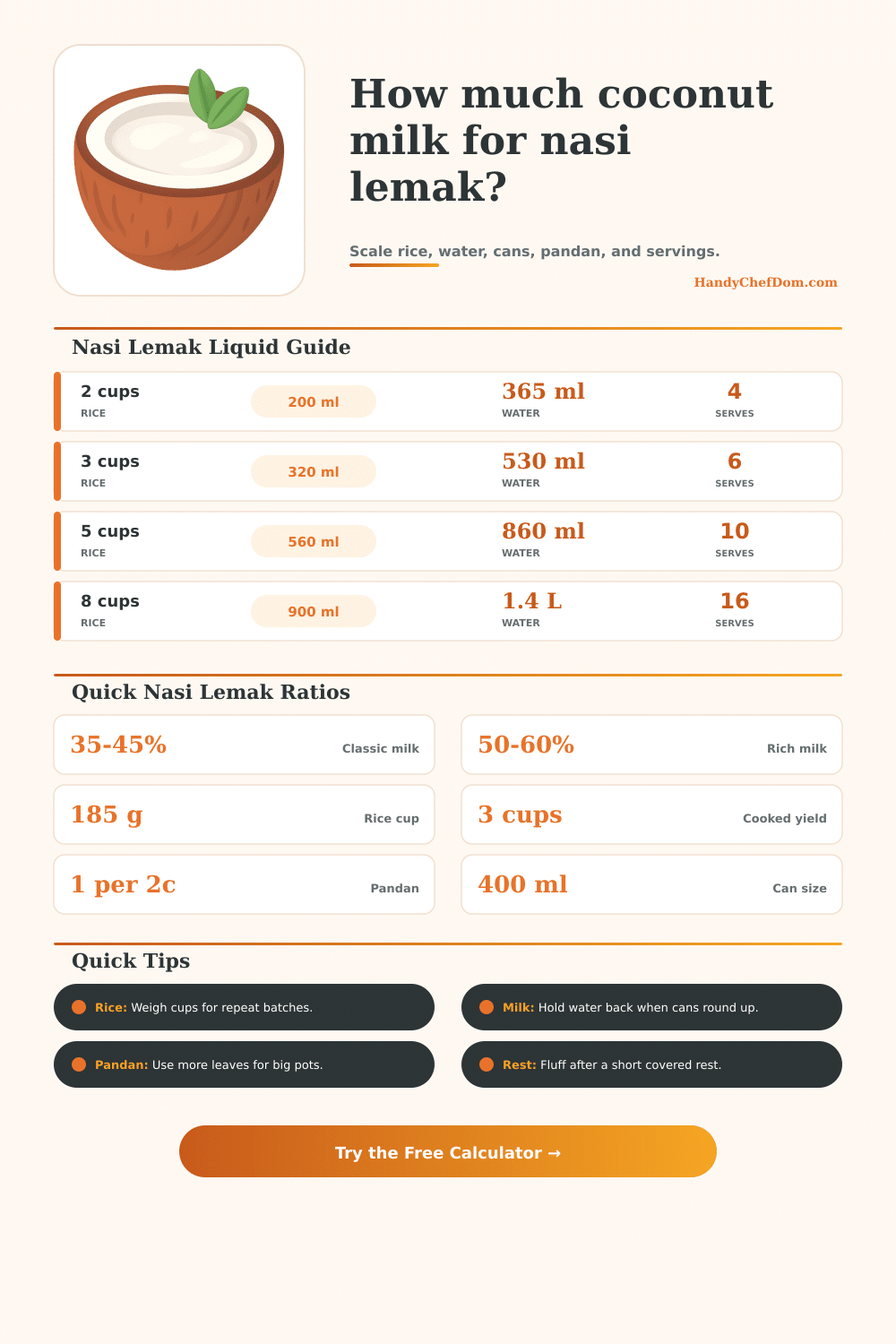
| 2 cups rice | 220 to 250 ml | About 0.6 can | 1 to 2 leaves, 2 slices |
| 3 cups rice | 320 to 380 ml | About 1 can | 2 leaves, 3 slices |
| 5 cups rice | 560 to 650 ml | 1.5 cans | 3 to 4 leaves, 5 slices |
| 8 cups rice | 900 to 1040 ml | 2.25 to 2.6 cans | 5 to 6 leaves, 8 slices |
| 12 cups rice | 1.35 to 1.55 L | 3.5 to 4 cans | 8 leaves, 12 slices |
6Method Comparison Grid
Best for repeatable nasi lemak. Use exact coconut milk, then fill the rest of the liquid target with water after rinse adjustment.
Useful when opening a 200 ml, 400 ml, or 560 ml can. The calculator rounds coconut milk and cuts water to keep the pot balanced.
Needs a little more liquid because the pot loses steam before the rice fully hydrates. Keep coconut percentage stable and add water.
High coconut percentages work best in smaller batches or with bold sambal, because fat can make large trays feel heavier.
7Two Practical Nasi Lemak Tips
The heart of nasi lemak is coconut milk, without this part, your rice will taste incomplete, as if it were merely an afterthought. This is also why getting the coconut milk correct are so important: it’s not just a matter of flavour but also one of liquid balance. Because coconut milk plays dual roles, providing aroma/aroma and fat, while also contributing some of the water required for cooking. If you adjust one without altering the other, texture changes rapidly. This is something most people figure out the hard way.
They read the label, notice it says to add a whole can and then find their pot is wet (or worse, heavy). The question isn’t “how much coconut milk do I need?” Rather, it’s “What percentage of the overall liquid should be coconut milk, and what percentage water?” This depends on several things: How many servings are you cooking? How rich do you want your final result?
How to Get the Right Amount of Liquid
For example, a lighter serving for breakfast could have about thirty percent coconut milk, while a richer weekend meal will skew more toward fifty percent. Once you know which direction you’re moving in, the calculator above does the math.
The rice is the starting point. Does it matter if you’re using long grain or brown, or fragrant jasmine? Yes: Brown and long grain will release starch at different rates, as will jasmine; they’ll pull up more (or less) liquid in response. Is the rice old? A little older is likely to need a bit more absorption than fresh-from-the-bag. And then there’s the rinse level: The water that stays clinging to grains after washing adds to the overall hydration. Adjust your added-liquid amount downward for that reason. It makes all the difference between tipping the pot over into dryland or mushland, but it’s a small adjustment.
Then there’s cooking method: A covered stovetop pot will lose more steam than a rice cooker, for instance, so you need to add more liquid. Pressure cookers does the reverse. These differences are reflected in a method factor that adjusts the base calculation because of the tool itself. But you get to decide on the coconut percentage, which is the flavor decision, not hiding it inside an automatic formula.
There’s another wrinkle: coconut milk also varies by fat level. You might think that using different amounts of various fat levels would balance out, but it won’t deliver same mouthfeel even if the volume stays the same. But it won’t taste the same in your mouth. You can input the fat content of the canned coconut milk on the calculator, and the resulting richness score tells you how rich the finished dish will be and whether it balances well with the other things on your plate (the sambal, say).
Ginger and pandan are easy things to overthink. A couple slivers of ginger bring warmth to the foreground (and then fade back), while one knotted leaf per two cups of rice imparts aroma but doesn’t turn the pot into perfume. Use the same approach with salt: It’s an ingredient whose presence can be felt either too strongly (leaving the coconut tasting flat) or too weakly (making it more savory than aromatic). The tool scales each of these ingredients relative to amount of rice, which means no need to remember a different ratio for each recipe volume.
But once you scale up, the practical payoff comes into play. Multiplying by four doesn’t necessarily mean you have a meal for four people on a weeknight. Multiply by 12, and you have to start thinking about rounding rules and can sizes. Keeping things clean with the math means using whole cans, and also cutting back on water. That way there’s no wasted coconut milk to worry about spoiling. The calculator tells you how many cans is needed and what remains, if anything. This way, you know whether to break out another can or tweak the coconut percent up or down to use what’s already open.
Sometimes people view nasi lemak rice as something you can add more sauce to at the end as a sort of “side”. The truth is that the rice is the foundation. If you get the ratio wrong between water and coconut then all the other ingredients has to do more to make up for it. If you nail the liquid at the beginning, the rice itself will already taste like what this entire meal should of tasted like.