🍰 Cornstarch to Make Cake Flour Calculator
Calculate how much all-purpose flour to remove and how much cornstarch to add for a cake-flour-style blend by cups, grams, protein target, cake type, sift cycles, and batch scale.
This tool treats cornstarch as a zero-protein diluter. It solves for the tablespoon replacement needed to move all-purpose flour toward the cake-flour protein target, then shows the familiar remove-and-replace method.
| Cake Type | Protein Target | Typical Starch Rate | Blend Note |
|---|---|---|---|
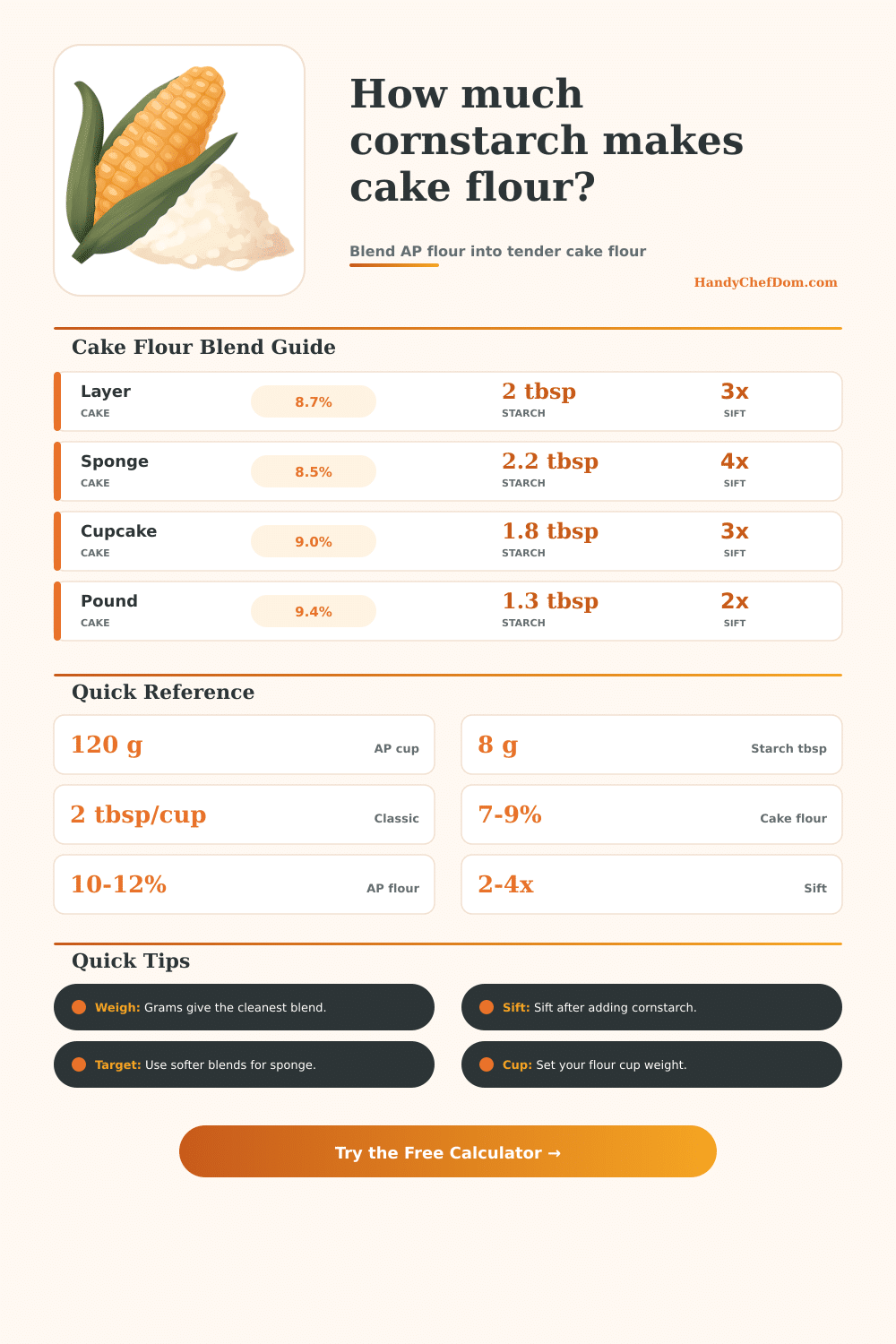
| Tender layer cake | 8.6% to 9.0% | About 2 tbsp per cup | Balanced softness for stacked cakes and butter cakes |
| Sponge or genoise | 8.2% to 8.7% | About 2 to 2.5 tbsp per cup | Lower protein supports lift and a fine, delicate crumb |
| Chiffon or angel-style crumb | 8.3% to 8.8% | About 2.1 tbsp per cup | Sift well so starch does not streak through foamed batter |
| Cupcakes | 8.8% to 9.2% | About 1.7 to 2 tbsp per cup | Slightly stronger blend helps small cakes dome neatly |
| Sheet cake | 8.9% to 9.4% | About 1.5 to 1.9 tbsp per cup | Good for larger pans that need a bit more structure |
| Pound cake, softened | 9.2% to 9.8% | About 1 to 1.5 tbsp per cup | Do not over-soften heavy batters that rely on structure |
| Starting Flour | Common Protein | Typical Cup Weight | Calculator Setup |
|---|---|---|---|
| Soft all-purpose flour | 9.0% to 10.0% | 118 g | Needs less cornstarch than stronger AP flour |
| Standard all-purpose flour | 10.0% to 11.2% | 120 g | Best match for the classic 2 tablespoon swap |
| Strong all-purpose flour | 11.3% to 12.2% | 125 g | May need more starch or a slightly higher target |
| Dip-measured cup | Same label protein | 128 g to 135 g | Use dip and sweep or enter your actual cup weight |
| Very light sifted cup | Same label protein | 105 g to 112 g | Use light cup mode only if recipe was written that way |
| Weighed flour recipe | Use label value | Not needed | Enter grams and choose already weighed style |
| Cornstarch Measure | Approx Grams | Flour Removed | Kitchen Use |
|---|---|---|---|
| 1 teaspoon | 2.7 g | 1 teaspoon flour | Tiny correction for a small test batter |
| 1 tablespoon | 8 g | 1 tablespoon flour | Mild softening for stronger all-purpose flour |
| 2 tablespoons | 16 g | 2 tablespoons flour | Classic cake flour substitute per cup |
| 1/4 cup | 32 g | 1/4 cup flour | Enough starch for roughly two cups of flour |
| 1/3 cup | 43 g | 1/3 cup flour | Useful for large layer cake batches |
| 100 grams | 12.5 tbsp | 12.5 tbsp flour | Large batch measurement by scale |
| Recipe Flour | Classic Cornstarch | AP Flour Removed | Sift Guidance |
|---|---|---|---|
| 1 cup AP flour | 2 tbsp / about 16 g | 2 tbsp / about 15 g | Sift at least twice after blending |
| 2 cups AP flour | 4 tbsp / about 32 g | 1/4 cup / about 30 g | Sift three times for layer cakes |
| 3 cups AP flour | 6 tbsp / about 48 g | 6 tbsp / about 45 g | Whisk first, then sift in batches |
| 500 g AP flour | About 66 g at classic rate | About 63 g AP flour | Weigh starch, then sift until uniform |
| 750 g AP flour | About 100 g at classic rate | About 94 g AP flour | Use a large bowl before sifting |
| 1000 g AP flour | About 133 g at classic rate | About 125 g AP flour | Blend in portions for even distribution |
Cornstarch is the secret ingredient to making cake flour at home. You’ll notice the difference in the crumb.
All-purpose flour has plenty of protein to form structure, which is great for bread and cookies. However, the same amount in layer cakes and sponges can make them taste a bit tough than usual. That’s where cornstarch comes into play: It adds no color or flavor of its own, but does lower the total protein.
How to Make Cake Flour at Home
Why does this work? Because protein percentage in the context of baking is simply a ratio. Take out a measured portion of all purpose flour and substitute with an equal (ish) amount of cornstarch, which acts as a neutral filler to dilute proteins, but also doesn’t change the overall volume very much relative to the rest of ingredients. This thins out the gluten-forming proteins without changing total volume much.
The tool does the math for you. All you do is plug in your original flour amount, the protein content listed on the package, and then the type of cake you want to make.
Why these factors? The type of cake you want to end up with matters: A pound cake require a stiffer batter than something like a sponge. The amount of starch you need depends on initial protein in your flour; if your protein is already high, you won’t need as much starch to reach the right level.
Keep an eye on cup weight too. A swept-and-dipped cup weighs more then one you sorta-spoon out. That’s additional flour before you ever get to the cornstarch step. Get this number right, and your end-protein calculation will be honest (not optimistic). Ditto for the cornstarch-per-tablespoon weight. Most folks uses a rounded eight grams. Small stuff add up over a big batch.
You can easily skip sifting your blended ingredients afterward, but it’s more important than most bakers realize. Without sufficiently even distribution of cornstarch, it settles into pockets that result in slightly gummy spots (or streaks) throughout the baked cake. It typically only takes two to four passes through a fine sieve to distribute the cornstarch evenly across the entire mixture. You can judge the estimated evenness from afar before mixing since the tool will keep track of the number of cycles you intend to go through.
And, as with any cooking project, it’s also the practical application: It’s easy enough to eyeball one cup, but not so much when you’re making eight cups (for the tiers of a cake!). Run the numbers before scaling up the whole recipe to keep things proportionate. This minimizes your chance to make measurement mistakes which tend to multiply if you measure incorrectly over and over again (across, say, eight cups).
I hear a lot of concerns about making your own cake flour: Will it behave like store-bought? Sometimes yes, sometimes no. Typically store-bought cake flour contain chlorine (to weaken the starch and allow it to absorb more moisture). You don’t get that with cornstarch by itself, so for super-fragile mixtures you might find that you have to adjust a tiny bit of liquid.
But for most cupcakes, layer cakes, and even chiffon, the slight change in protein make for a noticeably lighter crumb. More than anything else, though, getting rid of the guesswork makes the calculator worth using. Previously we had nothing but rough rules of thumb to guide us through this process. Now that you know exactly what each setting means, you can choose based off your flour and how you like your cakes.
Does a simple two-tablespoon swap work for you, or do you have a specific amount in mind? It’s that choice that makes an otherwise good cake one that’s purposefully tender.