🍖 Meatballs Per Pound Calculator
Estimate meatballs per pound by size, meat blend, shrinkage, serving style, and batch yield before you portion the mix.
Enter raw meat weight and meatball diameter. The calculator estimates raw meatballs per pound, cooked batch weight after shrinkage, and how many servings the batch covers.
| Meatball size | Diameter | Raw weight | Meatballs per lb |
|---|---|---|---|
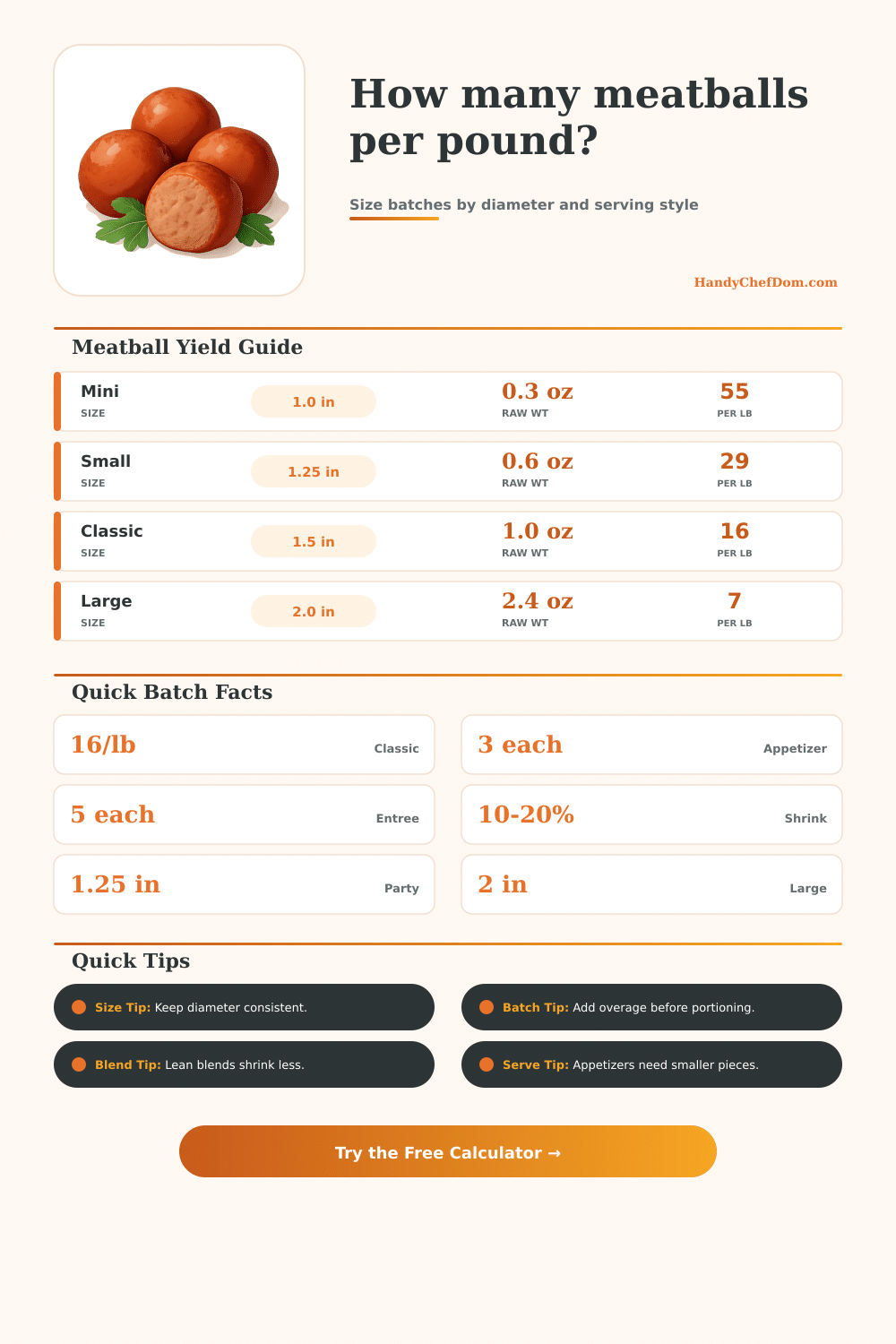
| Tiny cocktail | 1.00 in | 0.29 oz | 55 |
| Mini appetizer | 1.15 in | 0.45 oz | 36 |
| Small party | 1.25 in | 0.58 oz | 28 |
| Medium sauce | 1.38 in | 0.78 oz | 21 |
| Classic dinner | 1.50 in | 1.00 oz | 16 |
| Sub sandwich | 1.65 in | 1.34 oz | 12 |
| Large entree | 1.80 in | 1.73 oz | 9 |
| Jumbo plate | 2.00 in | 2.37 oz | 7 |
| Serving style | Meatballs each | Best diameter | Raw meat for 10 |
|---|---|---|---|
| Appetizer tray | 3 | 1.00-1.25 in | 0.6-1.1 lb |
| Pasta topping | 4 | 1.25-1.50 in | 1.4-2.5 lb |
| Entree plate | 5 | 1.50 in | 3.1 lb |
| Sub sandwiches | 4 | 1.50-1.65 in | 2.5-3.4 lb |
| Buffet side | 2.5 | 1.25 in | 0.9 lb |
| Meal prep bowl | 6 | 1.38-1.50 in | 2.9-3.8 lb |
| Meat blend | Density | Typical shrink | Best use |
|---|---|---|---|
| 80/20 beef | 0.96 g/ml | 18% | Classic dinner |
| Lean beef | 0.98 g/ml | 14% | Meal prep |
| Beef and pork | 0.97 g/ml | 17% | Pasta sauce |
| Turkey | 0.98 g/ml | 12% | Lighter entree |
| Chicken | 0.99 g/ml | 11% | Small meatballs |
| Pork | 0.97 g/ml | 16% | Party trays |
| Lamb | 0.96 g/ml | 19% | Hearty plates |
| Plant based | 1.02 g/ml | 10% | Mixed menu |
| Batch size | Appetizer count | Entree count | Classic raw meat |
|---|---|---|---|
| Dinner for 4 | 12 small | 20 classic | 1.25 lb |
| Family of 6 | 18 small | 30 classic | 1.9 lb |
| Party of 12 | 36 small | 60 classic | 3.8 lb |
| Potluck 25 | 75 small | 125 classic | 7.8 lb |
| Event for 50 | 150 small | 250 classic | 15.6 lb |
| Meal prep 10 | 30 small | 60 classic | 3.8 lb |
Home cooks don’t tend to measure their meatballs in weight but in volume: Scoop some seasoned ground beef into bowl until it seems like it’ll be enough for four plates (or an appetizer tray). It usually doesn’t, since there are two variables at play, raw density and shrinkage after cooking. Enter the calculator; tell it how big your balls are and what serving size you want, and let it crunch numbers for you… without having to guess if three pounds of meat is a feast or a famine.
The first variable to alter your result is size. One inch isn’t the same as two inches. Doubling the diameter increase its volume eight times because of geometry (the cube of radius). Thus, a small adjustment in scoop size leads to huge difference in yield per pound. That’s why eyeballing portions often fails for many.
Why You Should Measure Your Meatballs
See how the reference table shows that a one-and-a-half-inch-diameter dinner meatball results in about sixteen units per pound. Meanwhile, tiny party bites can produce upwards of fifty-five units from the exact same amount of raw material. It’s not just a matter of taste, it’s a question of arithmetic survival.
Now, how dense your meatballs will be depends on what kind of meat you use, and the amount they shrink will also depend on which meat you choose. If you use a leaner option, such as ground chicken or turkey, it won’t have much fat to render out, so it won’t lose as much water when cooked. An eighty-twenty beef mix are going to shrink a lot at higher temperatures, whereas a ground turkey (which starts as a leaner pound) holds its shape better before it gets cooked.
If you’re making these into stand alone entrees, that shrinkage affect how satisfying portions will be. To accommodate that, the tool allow you to choose exactly which proteins are being used in the blend, so it can adjust the expected cooked weight accordingly. You don’t need to memorize precise density coefficient, but knowing that fat = moisture loss makes sense of why whatever’s in pan looks smaller than what was in bowl.
The number of meatballs per person is determined by serving size. Tiny little morsels are perfect for an appetizer tray; visual abundance allows guests to grab three or four little bites without thinking much about sustenance. Larger spheres are necessary for entree plates because you’re looking for some real fullness in what’s placed before them.
While thirty-six tiny appetizer-size meatballs could easily satisfy a crowd of twelve, those same twelve people would be fuming around a dinner table with just two large meatballs on their plate. To move from social obligation to actualy raw ingredient costs, the calculator asks how many people is coming and how many meatballs you’d like each to have. With this information it can tell you if you’ve got enough meat to go around, or whether you should of run out and get more.
Thermal cooking always causes shrinkage, though this can be planned for depending on your planning horizon. A ten percent overage buffer (i.e., add an extra 10% to your raw weight calculation) will protect against any variation in scoop size as well as the surprise arrival of extra guests. At such a minimal cost in groceries, that little margin of error prevents you from having to scramble if the tray ever runs dry. It is a cheap insurance policy against potential culinary embarrassment.
A great rule of thumb for cooking meatballs is this: Approach it less like art and more like mathematics. Brown liberally and season freely, yes, but also measure accurately. Whether you’re serving four people or a roomful during the holidays, there’s nothing worse than guessing at proportions when you could know how many meatballs your pound of beef will actualy make. Respect that amount of weight for the volume before baking, and you’ll go from a dry dish to a party success.