🧀 Nacho Chips Calorie Calculator
Estimate chip calories by weight or count, then add cheese, salsa, guacamole, sour cream, toppings, tray servings, and broken chip waste.
Use chip weight for the most accurate result, or switch to chip count when you only know how many whole chips are on the plate.
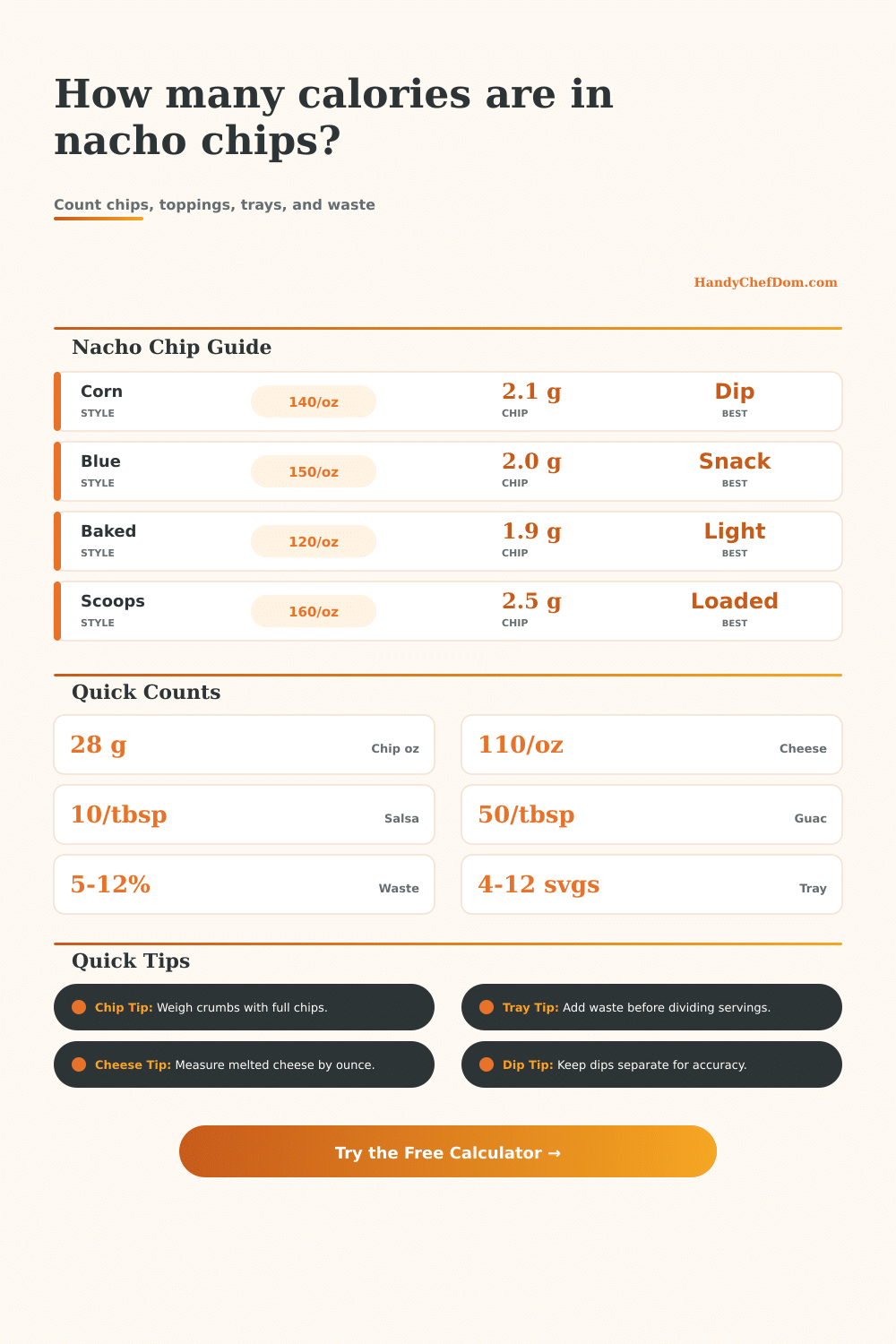
| Chip | Kcal/Oz | g/Chip | Use |
|---|---|---|---|
| Restaurant | 140 | 2.2 | Tray |
| Yellow | 146 | 2.1 | Bowl |
| White | 140 | 2.0 | Dip |
| Blue | 150 | 2.0 | Snack |
| Baked | 120 | 1.9 | Light |
| Scoops | 160 | 2.5 | Loaded |
| Topping | Portion | Kcal | Note |
|---|---|---|---|
| Nacho | 1 oz | 70 | Sauce |
| Cheddar | 1 oz | 115 | Rich |
| Salsa | 1 tbsp | 10 | Fresh |
| Guac | 1 tbsp | 50 | Dense |
| Sour | 1 tbsp | 30 | Creamy |
| Beans | 1 tbsp | 14 | Filling |
| Setting | Chips | Top | Serves |
|---|---|---|---|
| Kids | 1 oz | Light | 1 |
| Snack | 2 oz | Dip | 1 |
| Movie | 4 oz | Loaded | 2 |
| Game | 10 oz | Heavy | 6 |
| Party | 16 oz | Mixed | 10 |
| Office | 20 oz | Side | 12 |
| Tray | Waste | Each | Note |
|---|---|---|---|
| Bowl | 3% | 2 oz | Low |
| Plate | 5% | 3 oz | Easy |
| Pan | 8% | 2 oz | Shared |
| Sheet | 10% | 1.8 oz | Wide |
| Buffet | 12% | 1.6 oz | Crowd |
| Bag Mix | 15% | 1.5 oz | Crumbs |
Calorie values are practical estimates based on common nutrition labels: chips per ounce, cheese per ounce, and dips by tablespoon.
A plate full of nachos will make you cringe. You know those chips is dense with calories. The cheese must be like liquid energy! And then there’s the guac. Healthy fat, so that counts for something.
Breaking out the calculator to see the big picture helps clear up the confusion: it turns that vague sense of indulgence into a clear picture of exactly what you are fueling your body with. What you’re really doing isn’t tallying the total, after all. It’s breaking things down, seeing what each component contribute to the whole and how much of it you was able to cram into your mouth versus how much fell onto the serving dish.
How to Count Calories in Your Nachos
A bag of chips doesn’t seem very large. It is not until you rip it open and discover you’ve got half a pound of fried corn staring back at you. This level of granularity require being specific. After plugging in amount of topping (and what type of chip) you want, it does the math for you (the above calculator). No need to try and translate ounces into calories, the calculator takes care of that for you.
Most folks begin with their base. Blue corn tends to weigh a little more per chip, making it denser overall. Standard yellow corn will be roughly a hundred forty calories per ounce. Baked will knock that down to approximately one hundred twenty. This seems like big savings, but then again, maybe you’ll end up eating more because they feel lighter. It’s all just a matter of realizing that it isn’t really about how many you’re eating, it’s more about the weight. A bag could be heavy, yet the contents may be thin and airy, so they has less mass. Thick scoops? Then you’re getting more calories per chip.
You can switch between count and weight inside tool, so you can input whatever info you do happen to have on hand.
Next is cheese. And here’s when numbers start getting crazy. An ounce of shredded cheddar has over a hundred fifteen calories in it. What about nacho cheese sauce? It has about seven times lesser, which is seventy calories for an ounce. If you melt some cheese onto a tray, it stretches out. But it also sticks to all the little nooks and crannies on the chip. You don’t eat the cheese; you eat a vehicle for it.
Choose which cheese you want from a dropdown menu. There is a big difference between a rich queso dip and something lighter. The calculator shows how this can add hundreds of calories to your intake if you’re at a party with a lot of people. You see, it’s simple to pour away, thinking nothing of it, until you realize the sauce itself will now be your dish’s most caloric component.
Sure, fresh toppings provide a little reprieve. But not as much as you’d expect. Salsa has about ten calories per tablespoon, which is relatively low-impact stuff. Guac is about fifty calories per tablespoon. Guacamole is nutritious, but it are dense. Sour cream is about thirty calories per spoonful. All these numbers sound low when you look at them on their own, but they adds up fast when you’re ladling them onto a huge sheet pan.
That’s what the calculator does next: It sums all that up, then divides by whatever serving size you’ve defined. This is important because portion distortion is very real. A single tray feels like four servings… until you remember that three other people want a second helping.
There’s also the hidden variable of waste. Crumbs and broken chips diminish the usable surface area where toppings go. Lose ten percent of your chips to breakage? You’re basically paying calories for nothing. It is nothing but garbage. To avoid high per-serving estimate, the tool factors in your waste percentage.
The game changes depending on the setting. For one small snack bowl it’s fine, but for a game day tray? It is a different animal. Think about it: you’re feeding people, so the density of toppings change. Toppings may be richer. Kids’ portions may consist only of chips and salsa, lowering the overall count. Stadium style boats are piled high with heavy cheese, beans, and meat, making each serving more like a meal. The tool lays all of this out clearly in its reference tables, explaining how topping richness, chip density, and waste rates combines.
After you have finished your calculations, it is helpful to step back and see the breakdown. Seventy percent of your nachos’ calories may be coming from chips and cheese and not those fresh vegetables! That can be a sobering realization. It helps put things into perspective.
What exactly *is* a nacho? In short, it is not about stopping anyone from having nachos. Because it’s about knowing the price. You can get baked chips, pile them with salsa, and maintain low calorie count. Or you can embrace all those calories and just eat less. It’s you who has the plan; the calculator merely gives you the information.
When you know one plateful can go well past six hundred calories, you have a frame of reference when deciding to order this as an entree or split it as a side dish. Your eyes become trained on the amount of cheese per chip, how much topping versus chip, the way the chips act as a vehicle for the cheese… and then there are always the crumbs.
The math, instead of confusing you, suddenly helps you enjoy the meal without being caught off guard by a post-lunch sluggishness. It makes a vague feeling of gluttony turn into a concrete image of precisely what you’re feeding yourself. Actualy, it is much better than guessing.