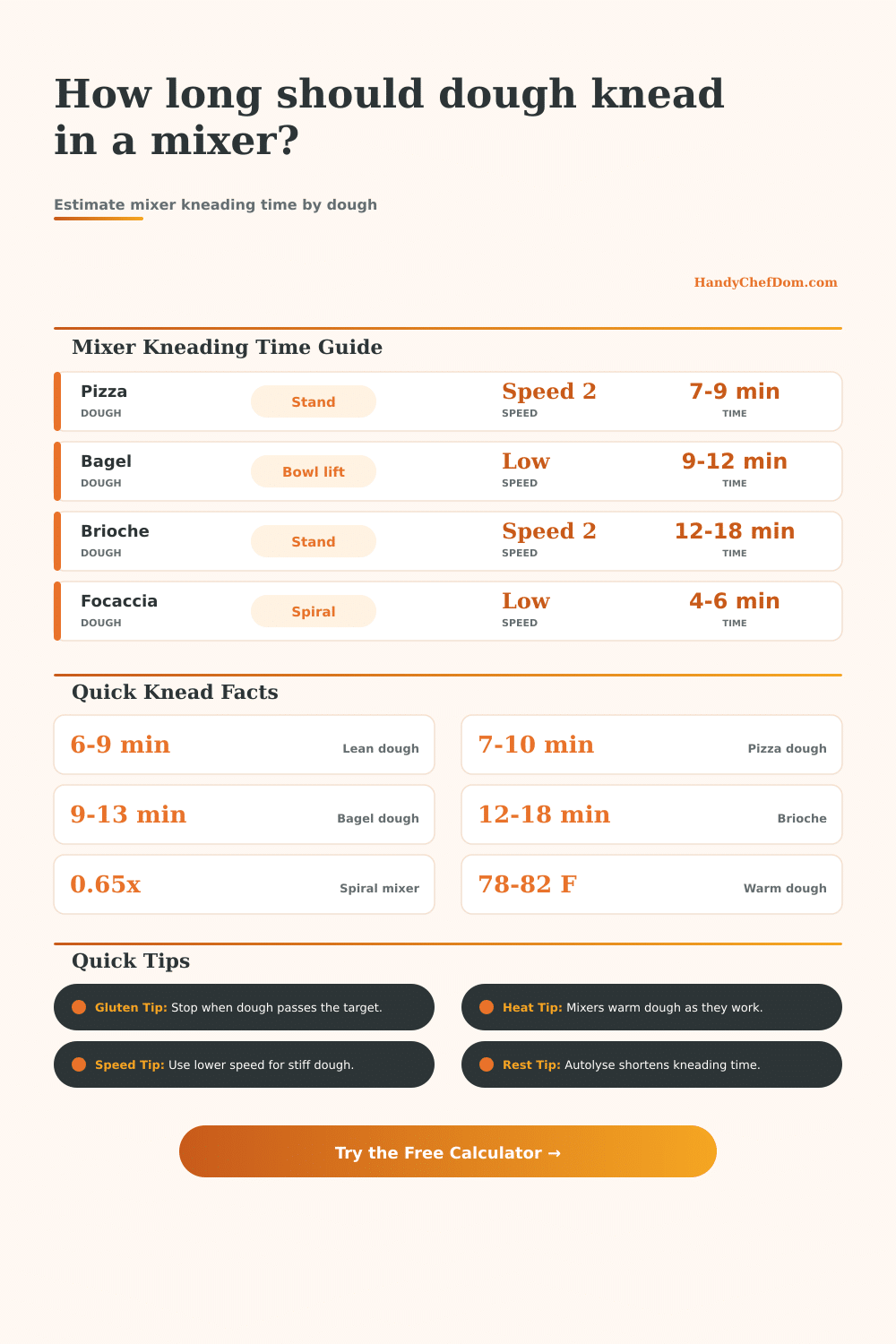
🍞 Dough in Mixer Kneading Time Calculator
Estimate mixer kneading time from dough type, flour weight, hydration, mixer type, speed, lean or enriched formula, whole grain percent, gluten target, dough temperature, batch load, and rest time.
Use flour weight and baker percentages. The estimate assumes a dough hook or spiral hook, then adjusts for dough stiffness, mixer strength, speed, enrichment, whole grain bran, target gluten development, dough temperature, and mixer bowl load.
| Dough Type | Hydration Range | Stand Mixer Time | Development Cue |
|---|---|---|---|
| Pizza dough | 58% to 70% | 7 to 10 minutes | Smooth, stretchy, and tacky but not soupy. |
| Sandwich loaf dough | 60% to 68% | 6 to 9 minutes | Elastic dough clears much of the bowl. |
| Bagel or pretzel dough | 50% to 58% | 9 to 13 minutes | Dense, firm, and satin-smooth. |
| Focaccia or ciabatta | 75% to 90% | 5 to 8 minutes | Glossy, stretchy dough with visible strength. |
| Brioche or rich dough | 50% to 65% | 12 to 18 minutes | Butter absorbed and dough pulls into strands. |
| Rye blend dough | 65% to 85% | 3 to 6 minutes | Cohesive paste or short gluten, not full windowpane. |
| Mixer Type | Best Load | Speed Approach | Time Effect |
|---|---|---|---|
| Compact stand mixer | Small soft doughs | Low speed with rests | Usually a little slower. |
| Tilt-head stand mixer | Moderate home doughs | Low-medium dough-hook speed | Baseline for this calculator. |
| Bowl-lift stand mixer | Larger bread batches | Low to low-medium | About 10% faster than tilt-head. |
| Commercial planetary | Repeated bakery batches | First or second speed | Often 15% to 20% faster. |
| Spiral mixer | Pizza, bread, high hydration | Low or two-speed mix | Often 30% to 40% faster. |
| Hand mixer dough hooks | Soft small dough only | Low speed, short rests | Slower and more load-sensitive. |
| Formula Factor | Shortens Knead | Lengthens Knead | What To Watch |
|---|---|---|---|
| Hydration | 68% to 78% extensible dough | Very stiff or very slack dough | Stiff dough strains mixer; slack dough may need folds. |
| Enrichment | Lean dough with little fat | Butter, sugar, eggs, or milk solids | Add fats after some gluten has formed when possible. |
| Whole grain | Low bran white flour | High bran or rye blends | Bran cuts gluten and can make windowpane less clean. |
| Autolyse | 20 to 45 minute flour rest | No rest before mixing | Rested dough usually smooths faster. |
| Dough temperature | 76 F to 80 F dough | Cold dough below 68 F | Cold butter and cold flour slow development. |
| Batch size | Bowl about one-third to half full | Overfilled bowl or tiny batch | Dough hook works best with enough contact. |
| Gluten Target | Best For | Stop Cue | Typical Window |
|---|---|---|---|
| Short mix | Rye blends, rustic sourdough | Cohesive dough with rough strength | 3 to 6 minutes |
| Moderate gluten | Pizza, focaccia, hearth bread | Smooth dough stretches without tearing quickly | 6 to 10 minutes |
| Strong gluten | Bagels, sandwich loaves | Elastic windowpane with some resistance | 8 to 13 minutes |
| Intensive mix | Soft pan bread and high volume loaves | Very smooth dough clears bowl and sheets thin | 10 to 16 minutes |
| Enriched staged mix | Brioche and sweet dough | Dough accepts butter and becomes glossy | 12 to 18 minutes |
| High hydration mix | Ciabatta and focaccia | Dough gathers, shines, and clings in strands | 5 to 9 minutes |
That’s where my dough ball calculator comes in: The calculator takes all that heavy lifting off you and adjusts based on what kind of mixer you use, how much water/hydration you’re using to make your dough, and whether or not you’ve enriched it. Instead of spitting out a single number, it provides a window. Because honestly, every batch isnt the same, and that’s an honest approach. When you know why you’ve entered certain inputs, it goes beyond following a recipe and makes you understand what’s going on.
Making bread dough doesn’t necessarily have anything to do with sticking to an exact minute mark; it has everything to do with knowing how to read your gluten as you knead. But sometimes, especially when it’s loud in the kitchen and timer is ticking down, you just want to start somewhere.
Why Mixing Time Changes
Hydration is typically the biggest variable. A high-hydration dough (think ciabatta, foccacia) will at first appear sloppy; however, as gluten network links up, it forms a quick structure. Although it may seem intuitive that a wetter dough requires more mixing to hold together, the opposite is true. To achieve extensibility, a wet dough simply take less time. And while machine handles the process, overmixing a wet dough creates a sticky mess that tears instead of stretches.
Conversely, on the other end of spectrum, bagel-like, stiff doughs fights against the hook. They require much more mechanical energy for protein alignment. In other words: increased friction heat and longer times. The downside? That heat’s the silent enemy of good bread. When dough rise in temperature too far during mixing, it activates the yeast prematurely. Which translates to loss of control over your fermentation schedule.
The other thing that changes the game is mixer mechanics. Home mixers are great, but most are tilt-head stand mixers and when full of heavy dough the head tilts up and down a bit as it struggles against weight. You lose efficiency from that slippage. Spiral mixers (and bowl lift models) keeps the dough in place. Allow the hook to do its work through the mass without dropping contact.
The calculator takes that into account. Often the spiral mixer is going to come back with a shorter time because it’s built to fold the dough onto itself repeatedly. That’s a gentler motion that gets the job done with less brute force. If you’re working with a compact mixer, it will probably tell you to lengthen the time. But you should be more patient, too. Small motors get hot fast. Pushing a stiff dough at high speed risks burning out the gears before the gluten has even formed.
There is another wrinkle called enrichment. When you enrich dough, you add extra fat that coats the gluten proteins. It keeps them from sticking together. And so a bread like brioche, which has much more butter, requires far more time to be kneaded compared too a plain old sandwich loaf. The butter slows down the formation of the network. It also acts as a lubricant.
Most recipes instruct you to add fat only after the flour and water have started forming some kind of structure. And the calculator’s default settings assumes this stepwise method. When you attempt to combine flour and butter initially, you’ll find yourself dealing with a weak, shaggy mess. No matter how long you operate the machine. You’re not mixing together ingredients; you’re developing strength.
Whole grains cause physical interference by acting like tiny knives that cut through gluten strands. The bran particles in whole wheat (or rye) cut up the web of strands into pieces, making it impossible to achieve a perfect windowpane test on a high percentage rye loaf. Why? Because there’s physical interference in the network. The tool compensates for this by reducing the suggested time.
Don’t try to strengthen your whole grain dough by overmixing. Doing so doesn’t make it stronger; it just makes it denser and tough. What you want here is cohesion (not elasticity). It sounds subtle, but it’s what distinguishes professional-quality bread from amateur bread.
You can reduce kneading time by using autolyse, which is resting the water and flour before you mix them. Because the natural hydration of the flour allows gluten formation even prior to any stirring action, all you need is half as long to get the desired dough strength. This is efficient (you use less energy) and it helps prevent the dough from heating up. The calculator takes this into account and subtracts some of this time from total estimate at the end. It is a little trick with a big payoff for the texture.
All that said, the clock is only a reference point. You’re looking for the dough to tell you when it’s right. When the surface becomes smooth and slightly glossy, that’s your cue. When it starts to come together in the machine, think about how the pitch changes on the motor. It will be coming up off the hook instead of fighting the hook. Reach out and touch it. Is it tearing? Then it’s not ready. Is it snapping back like a rubber band? Almost there.
Take the guesswork out by planning your day using the estimates. But rely on your senses for the finishing touches. Balance the art and science of it; know when to give it room to breathe and when to get out of the way and let the dough rest. That’s where best loaves are made.