🥧 Cornstarch per Apple Pie Calculator
Estimate cornstarch thickener for apple pie from apple weight or cups, apple juiciness, sugar amount, pie size, filling depth, raw or pre-cooked filling, target slice set, added lemon or liquid, and cooling time.
Use sliced apple cups for fast planning or apple weight for a tighter result. The calculator adjusts the cornstarch rate for juicy apples, sugar draw, filling depth, raw or pre-cooked filling, added lemon or liquid, and cooling time.
| Apple Type | Juice Behavior | Base Cornstarch Rate | Pie Planning Note |
|---|---|---|---|
| Granny Smith or firm tart apples | Lower juice, firm slices | 0.25 to 0.30 tbsp per cup | Good for clean slices without a heavy gel texture. |
| Honeycrisp or juicy crisp apples | Moderate to high juice | 0.32 to 0.40 tbsp per cup | Increase when sugar rests on apples before filling. |
| Gala, Fuji, or sweet apples | Medium juice, softer bite | 0.30 to 0.36 tbsp per cup | Works best with a firm-slice target and full cooling time. |
| McIntosh or soft juicy apples | High juice and soft texture | 0.38 to 0.50 tbsp per cup | Use more thickener or pre-cook to avoid a runny center. |
| Frozen sliced apples | Extra released liquid after thawing | 0.42 to 0.55 tbsp per cup | Drain or reduce liquid if you want a cleaner slice. |
| Canned apples, drained | Liquid already released | 0.18 to 0.28 tbsp per cup | Usually needs less starch because the filling is already softened. |
| Pie Format | Typical Apple Cups | Filling Depth | Cornstarch Cue |
|---|---|---|---|
| 6-inch mini pie | 2 to 3 cups | 1.1 to 1.4 inches | Use the calculator result, then round to the nearest teaspoon. |
| 8-inch pie | 4 to 5 cups | 1.4 to 1.6 inches | Balanced rate works for normal apples and a full cool. |
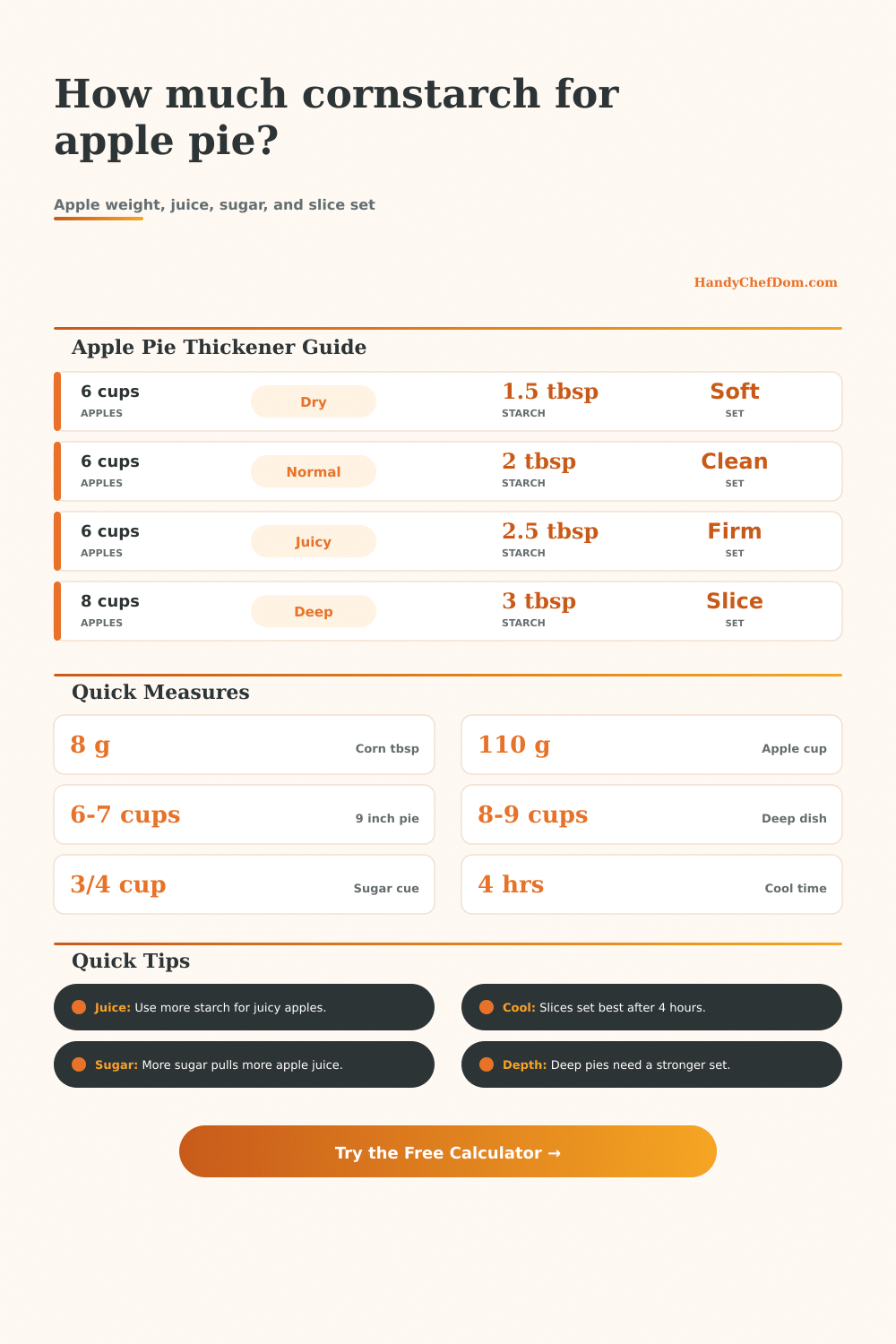
| 9-inch standard pie | 6 to 7 cups | 1.5 to 1.9 inches | Most classic apple pies land near 2 tablespoons cornstarch. |
| 10-inch pie | 8 to 9 cups | 1.7 to 2.1 inches | Watch the fill load because deep slices hold more syrup. |
| Deep-dish pie | 8 to 10 cups | 2.0 to 2.6 inches | Add a small firm-set boost unless the filling is pre-cooked. |
| Slab pie or sheet pie | 10 to 16 cups | 0.8 to 1.3 inches | Use a stronger set when slices must lift cleanly from a pan. |
| Filling Method | Juice Control | Calculator Factor | Slice Result |
|---|---|---|---|
| Raw apples mixed and baked | Juice releases inside the crust | 1.00x | Classic result when cooled completely. |
| Macerated and drained | Some juice removed or reduced first | 0.85x | Cleaner slice with less surprise liquid. |
| Pre-cooked stovetop filling | Starch hydrates before baking | 0.65x | Lower starch can still set because liquid is controlled. |
| Canned apples, drained | Syrup is mostly controlled already | 0.55x | Use light thickening unless syrup is added back. |
| Frozen apples after thawing | Thaw liquid increases the load | 1.15x | Plan extra starch or drain before filling. |
| Thickener Or Measure | Equivalent To 1 Tbsp Cornstarch | Best Use | Texture Note |
|---|---|---|---|
| Cornstarch | 1 tbsp, about 8 g | Clearer gel and clean slice | Best when pie fully cools before slicing. |
| All-purpose flour | 2 tbsp, about 16 g | Traditional cloudy filling | Needs more volume and gives a softer set. |
| Quick tapioca | 1.5 tbsp, about 13 g | Juicy fruit pies | Sets well but may show tiny pearls if not rested. |
| Apple cup | About 110 g sliced | Fast filling estimate | Dense slices and chopped apples can weigh more. |
| Lemon juice | 1 tbsp, about 15 ml | Brightness and tart balance | Added liquid slightly increases thickener demand. |
Slicing through an apple pie and finding the filling running out all over your hands can be frustrating. It’s not necessarily due to a lack of skills, but rather a matter of mathematics. Most times, it’s a question of how much thickener was addid.
When cooked with cornstarch, which makes for a translucent gel, fruit shows through. But if there is too much cornstarch, the pie becomes a brick; too little and you’re left with a runny mess. Achieving the proper balance between these two extremes mean the difference between a slice that lifts cleanly onto a plate and one that require a spoon.
How to Make the Right Pie Filling
That brings us to one other variable, moisture content in apples themselves. Baking will cause juicier apples to give up their liquid, thinning out the cornstarch and making it less effective; on the other hand, dry apples will be less prone to giving up moisture. Therefore, if they is all the same, the wetter apples will make a looser filling.
Oops! The solution is to enter kind of apple into the calculator and it’ll do the math for you. Sweeter apples are typically juicier and will release more liquid then drier apples. That means that sometimes you might want a touch more starch, depending on how firm-set you like your apples. It is a small change but an important one for the end result.
Many bakers forget about one thing: sugar is part of the equation. Sugar sucks moisture from the apple. The sweeter the pie, the more moisture go into the filling. It tastes better! But if you don’t compensate by adjusting your thickener, it will be less stable. More brown sugar means needing more cornstarch. Too much sugar and too little thickener = runny middle. Tool considers the suck-out effect of the sugar. So you have as much thickener as there is real liquid in the pan.
The physics of the bake depends on depth. A standard nine-inch pie holds about six to seven cups of filling, but a deep-dish pie can hold double that amount. That means there is more heat and moisture in one spot. The extra volume of a deeper dish also require more time to reach temperature. It also results in a higher mass, requiring a sturdier set to retain it.
When you increase the overall surface area (say, with a slab pie), there is less depth but more escape routes for the steam. Knowing this give you context for whether your slice should be firmer.
Cooking your filling is an acceptable plan… but it alters things. Cooking apples with lemon juice and sugar first will cause some of the water to evaporate. This means that starch starts working earlier. Therefore: You’ll require less cornstarch than if the fruit was raw. If you use the same amount in a pre-baked pie, it will be gooey. The calculator adjusts its recommendation for pre-baking accordingly.
It also considers the cool-down period. The pie will still firm as it cools, while the cornstarch set. A slice cut from a hot pie often looks tight. Give it a few hours (four, actualy) and the gel structure would of had a chance to take shape.