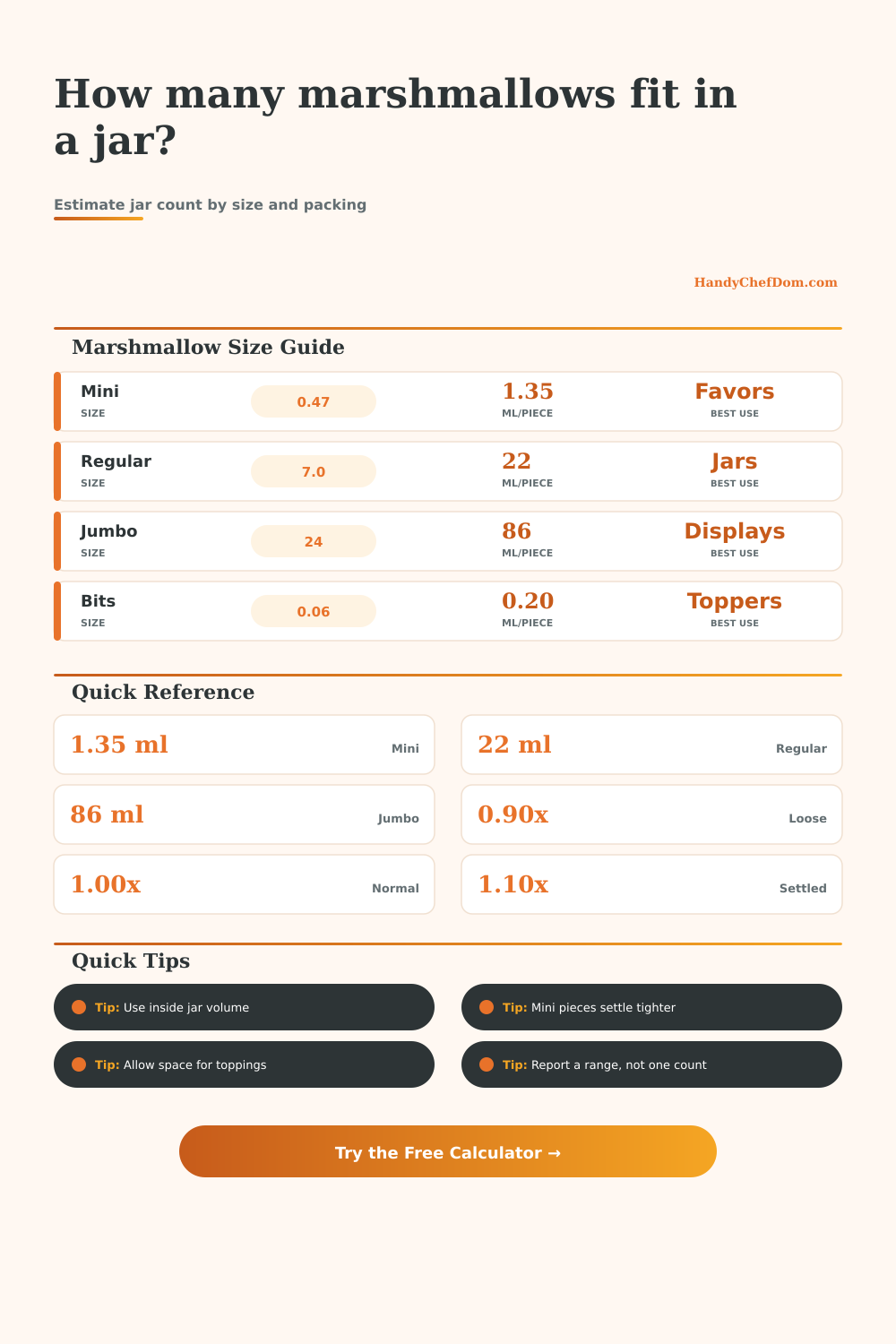
Marshmallows per Jar Calculator
Estimate how many mini, regular, or jumbo marshmallows fit in a jar after fill level, shape, packing density, air gaps, toppings, and mix-ins.
Use inside jar dimensions or a known jar volume. The estimate treats marshmallows as soft pieces with variable air gaps, so the final count is shown with a practical range.
| Size | Approx Weight | Bulk Volume | Best Jar Use |
|---|---|---|---|
| Marshmallow bits | 0.06 g | 0.20 mL | Topping jars |
| Flat cereal marshmallows | 0.12 g | 0.42 mL | Layered gifts |
| Mini marshmallows | 0.47 g | 1.35 mL | Favor jars |
| Regular marshmallows | 7.0 g | 22 mL | Quart jars |
| Jumbo marshmallows | 24 g | 86 mL | Display jars |
| Homemade small cubes | 5.5 g | 18 mL | Gift boxes |
| Homemade large cubes | 12 g | 42 mL | Wide jars |
| Packing Style | Count Factor | Typical Air | Jar Note |
|---|---|---|---|
| Loose pour | 0.90x | 12-18% | Fluffy top |
| Normal fill | 1.00x | 8-12% | Everyday jar |
| Lightly settled | 1.07x | 6-10% | Gentle tap |
| Shaken down | 1.14x | 4-8% | Tighter count |
| Gently compressed | 1.22x | 2-6% | Soft squeeze |
| Jar Size | Approx mL | Mini Count | Regular Count |
|---|---|---|---|
| 4 fl oz jar | 118 | ~79 | ~5 |
| 8 fl oz jar | 237 | ~158 | ~10 |
| 16 fl oz pint | 473 | ~315 | ~19 |
| 32 fl oz quart | 946 | ~631 | ~39 |
| 64 fl oz half gal | 1893 | ~1262 | ~77 |
| 1 gallon jar | 3785 | ~2524 | ~155 |
0.5 cup
1 cup
1 pint
1 quart
| Volume | mL | fl oz | Cups |
|---|---|---|---|
| 1/2 cup | 118 | 4 | 0.5 |
| 1 cup | 237 | 8 | 1 |
| 1 pint | 473 | 16 | 2 |
| 1 quart | 946 | 32 | 4 |
| 1/2 gallon | 1893 | 64 | 8 |
| 1 gallon | 3785 | 128 | 16 |
If you ever find yourself with a jar full of marshmallows that just won’t close, there’s a certain kind of panic that set in. Don’t worry: You’re not alone. More often than not, it isn’t a matter of skill. It is just geometry. Fitting these pliable, formless blobs into glass cylinders are a tricky business that doesn’t divide neatly. There is space between them. There is the amount they compress when tapped inside the jar. There is the volume of their sugary shell.
Thankfully, you don’t have to fiddle about with coefficients: Enter the size of your jars and let the calculator do the number-crunching. How do we start? We start by measuring the jar properly. The majority measure outside of the jar with a tape measure. That is wrong. The shoulders taper. The glass are thicker in some spots than others. And what about lids? Those take up space too. Measuring the outside dimension is like figuring out how much gas fits into a 20-gallon drum if its walls were paper-thin. No such beast exist. What you need is the internal fill height and inside diameter. There is no excuse. Many commercially available jars will have the manufacturer’s volume; however, stated volume is typicaly used for marketing (not actual physical capacity). It is a small detail, but it matter when your margin is thin.
How to Fit Marshmallows in a Jar
Okay fine, so what about those marshmallows? They’re not all brick-like. Granular materials (like mini marshmallows) has no set shape. They will flow. And as they settle, they’ll fill in crevices. Solid materials (such as regular or jumbo marshmallows) have more dead space surrounding them, thus they packs less efficiently. Because of this, size of the piece matters: mini marshmallows pack more tightly then jumbo ones because their larger surface area allow them to fit better into empty spaces. That’s why despite seeming visually similar, a jar full of minis weigh more than a jar of jumbos.
Why does that matter? Because the air gap lowers your count. The intuition here go out the window with packing density. Loose packing will give you a lower count (fluffy top). Gently shaking the jar will increase the count as they settle down. Tapping the jar lightly on the counter will also create higher density. This will probably crush some of the pieces and change their volume too. This is what the calculator can be adjusted for: for packing density. It’s really a choice about accepting air in your final product. Do you want it to look like a loose pack (airy but may spill if the lid gets screwed on)? Or do you want it to look impressive but feel dense (tight pack).
Never overlook toppings. Adding a coating of chocolate or a dusting of cocoa makes each piece thicker. Now it is no longer just about the marshmallow; it is about the marshmallow plus what is on top. These toppings include coatings, and they matter to the tool because they change how much actual marshmallow each unit effectively holds. Adding a sprinkle or chocolate chip or any other mix-in take up volume that would otherwise be marshmallow. You have to subtract that amount as a percentage of total volume of your marshmallow. It is simple subtraction, but it is easy to lose track of if you’re thinking about the look.
It is not one number, but a range. Why? That’s not a bug. It’s a feature. Soft things deform; marshmallows does that. No two people will put the same number of marshmallow in a jar. But the range buffers that fact for you, and it allow for the natural variability of soft matter. Want to play it safe? Go with the lower end of the range. Want to go all-in? Shake that sucker down hard and use the high end.
But in the end, it’s all about managing expectations. Fill the jar too much and it will burst at the seams; fill it too little and it won’t seem like much of a gift. You should of known. Follow the numbers, yes, but use your hands. Measure. Pick a size. Consider the air. Fill it up. Tap it gently one, two times. When the lid clicks into place with satisfaction… Success! Are those sticks? Ahh, well then, lesson learned. Next time will be better. Math holds. Clouds settle.