Kale Calcium Calculator
Estimate calcium, daily value coverage, and nutrition from raw, cooked, frozen, or wilted kale portions
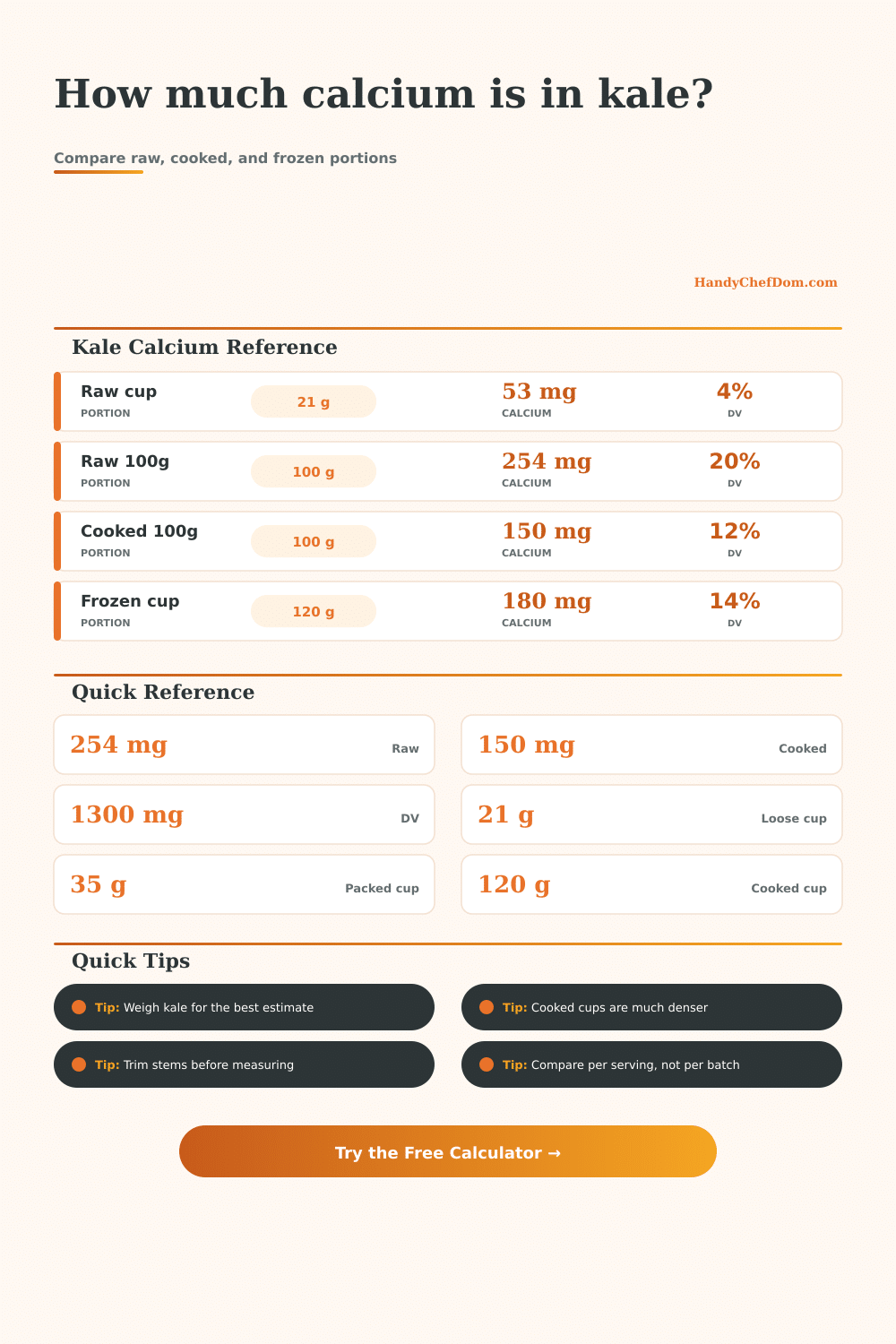
Reference values are per 100 g unless noted. Raw and cooked values are based on USDA FoodData Central data mirrored by public nutrition databases.
| Kale Form | Calcium | Calories | Best Measuring Method |
|---|---|---|---|
| Raw curly kale | 254 mg/100 g | 35 kcal/100 g | Weighed grams |
| Raw baby kale | 254 mg/100 g | 35 kcal/100 g | Loose cups or grams |
| Raw lacinato kale | 254 mg/100 g | 35 kcal/100 g | Ribboned cups |
| Cooked boiled drained | 150 mg/100 g | 36 kcal/100 g | Cooked drained weight |
| Frozen cooked drained | 150 mg/100 g | 36 kcal/100 g | Drained cooked cups |
| Steamed estimate | 210 mg/100 g | 35 kcal/100 g | Cooked weight estimate |
| Portion | Typical Weight | Calcium Estimate | Use Case |
|---|---|---|---|
| 1 loose raw cup | 21 g | 53 mg | Light salad handful |
| 1 standard raw cup | 28 g | 71 mg | Chopped side salad |
| 1 packed raw cup | 35 g | 89 mg | Smoothie greens |
| 1 cooked drained cup | 120 g | 180 mg | Dense cooked side |
| 1 average bunch edible | 198 g | 503 mg | Trimmed grocery bunch |
| 100 g raw weighed | 100 g | 254 mg | Most accurate entry |
| Target | Raw Kale Needed | Cooked Kale Needed | Planning Note |
|---|---|---|---|
| 100 mg | 39 g | 67 g | Small add-in portion |
| 250 mg | 98 g | 167 g | Large raw salad |
| 500 mg | 197 g | 333 g | Full bunch range |
| 650 mg | 256 g | 433 g | Half of 1300 mg DV |
| 1000 mg | 394 g | 667 g | Very large kale amount |
| 1300 mg | 512 g | 867 g | Daily value reference |
| Green | Reference Portion | Calcium | Comparison Note |
|---|---|---|---|
| Kale, raw | 100 g | 254 mg | High calcium per raw weight |
| Kale, cooked | 100 g | 150 mg | Denser cooked portion |
| Arugula, raw | 1 cup | 125 mg | UCSF cup reference |
| Broccoli, cooked | 1 cup | 180 mg | UCSF cup reference |
| Dandelion greens | 1 cup | 80 mg | UCSF cup reference |
| Turnip greens, raw | 1 cup | 80 mg | UCSF cup reference |
When you think about kale, you probably imagine a fibrous leafy green: chewy enough to be painful (if one were so inclined) or earthy enough to be delicious. But for most people interested in making this green vegetable part of their regular diet, that’s typically not the issue. The challenge is more related to volume and nutrient density, namely its calcium content. A handful tossed into a smoothie? You’re hardly scratching the surface of your bone minerals‘ true needs, despite thinking you’ve got all bases covered for the day.
Easy to do when what you weigh can feel like what you are eating. But, unfortunatley, it is not. In fact, I found that the ruffled surface of curly kale actualy captures a lot of air inside each leaf. Even though a loose cup may look large in your palm, it will only weigh as much as about 20 grams, about a tenth of what you would assume when expecting a hundred-gram bunch! This is also part of the reason that volume measurements aren’t nearly as accurate than weight: Tossing loose kale around creates a very different density than chopping it up finely for a salad, or packing it tightly inside a smoothie blender. A loose cup contain much less leafy material, and therefore much less calcium, than a tight-packed cup.
Why Volume Is Not Accurate For Measuring Kale
After plugging in how you prepare it, the calculator does all the calculations for you so you don’t have to guess at the true nutritional value you’re consuming. The other wrinkle in cooking kale throws lots of people off. Kale shrink down and wilts when it’s cooked (whether boiled or steamed), making cooked servings much heavier in terms of volume. So while a cup of raw kale has much less weight and calcium than a cup of cooked greens, the cooked greens has a lot more. But if you boil those greens, you can leech out some of those water-soluble nutrients, tipping things in the opposite direction. And then you’ve got frozen kale, which has an entirely new set of nutrients (and textures!) with varying levels of minerals depending on how it is processed before freezing.
Know what’s up here. And use that knowledge to reset your expectations instead of getting frustrated when the outcome isn’t what a general nutrition label suggests. Other examples: There’s a reference table for lacinato (a.k.a. Dinosaur) kale. Its leaves are flatter than curled curly kale, so it have a different weight per volume. And it factors in trimming the stems. Why not? That’s a practical thing to do, and a thick rib adds bulk without many nutrients. Trim it, and your edible part diminishes (so the amount of calcium you ultimately yield from a given bunch are lower).
Real-world details like this is something static charts hardly ever show. It lets you visualize just how much is left, once waste is subtracted, and that helps you know precisely how much edible stuff will be ending up in your belly. Your aim isn’t necessarily to eat X number of calories; typically, it’s to reach a certain daily amount, such as the 1300mg of calcium recommended for the average adult. Unless you’re eating only kale (and even then), you won’t get that much from kale by itself. But a careful serving here and there can be a significant addition, and when combined with other calcium sources, or eaten in portions calculated carefully using actual weights, it could of made all the difference.
Because it’s not so much about heaping mounds of leafy green onto your plate as it is about being intentional about what you do put on it. Measure first, guess second, and before long, kale goes from scary superhero food to nutritious cornerstone of your plan.