🦃 Turkey Fryer Oil Calculator
Estimate turkey fryer oil by pot geometry, turkey displacement, fill line, safety headspace, oil type, and batch count.
Use the pot diameter and target submerged fill line to estimate the oil level before the turkey goes in. The calculator subtracts turkey displacement and checks rim headspace.
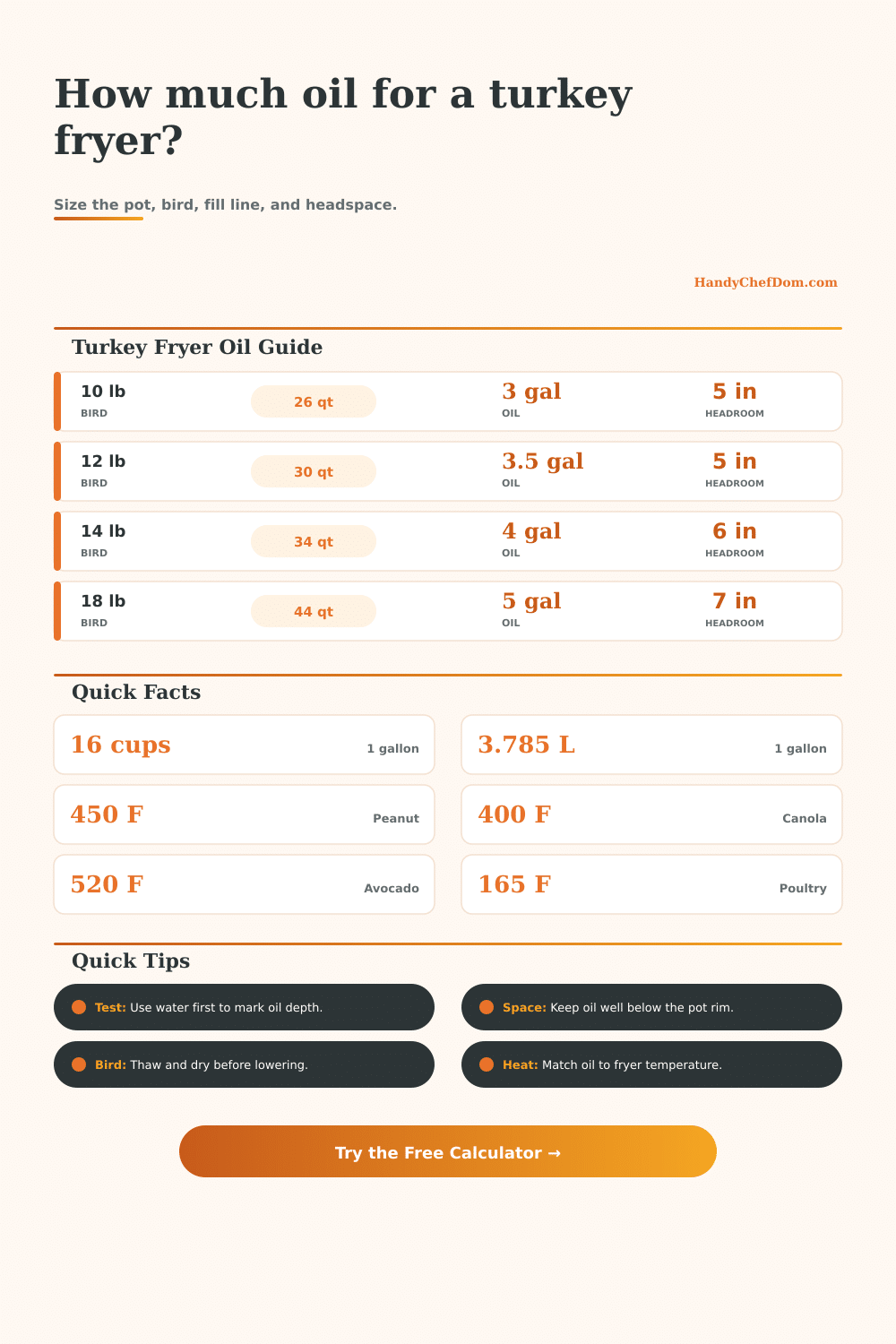
| Turkey Size | Typical Pot | Starting Oil | Fill Headspace |
|---|---|---|---|
| 8-10 lb whole turkey | 26-30 qt | 2.75-3.25 gal | At least 5 in |
| 11-13 lb whole turkey | 30-34 qt | 3.25-4.00 gal | At least 5 in |
| 14-16 lb whole turkey | 34-40 qt | 4.00-4.75 gal | At least 6 in |
| 17-20 lb whole turkey | 40-44 qt | 4.75-5.50 gal | At least 7 in |
| Oil Type | Approx Smoke Point | Fryer Temp Margin | Calculator Use |
|---|---|---|---|
| Avocado oil | 520 F | Very high | Wide margin |
| Peanut oil | 450 F | High | Classic turkey frying |
| Neutral frying blend | 425 F | Moderate-high | General frying |
| Canola oil | 400 F | Moderate | Watch temperature |
| Extra virgin olive oil | 375 F | Low | Not ideal for turkey fryers |
| Butter | 350 F | Too low | Avoid as fryer oil |
| Measure | Cups | Liters | Use |
|---|---|---|---|
| 1 gallon | 16 cups | 3.785 L | Base conversion |
| 3 gallons | 48 cups | 11.36 L | Small fryer |
| 4 gallons | 64 cups | 15.14 L | Common turkey pot |
| 5 gallons | 80 cups | 18.93 L | Large fryer |
| Check | Target | Why It Matters | Calculator Field |
|---|---|---|---|
| Water test | Before oil | Confirms displacement | Fill line |
| Rim space | 5-7 in | Reduces overflow risk | Headspace |
| Oil heat | Under smoke point | Protects oil quality | Oil type |
| Poultry temp | 165 F | USDA safe minimum | Food thermometer |
A big pot, a frozen bird, and a bucket of hot oil is staring back at you. A half hour later, you have crispy skin and juicy meat: deep fried turkey.
But there’s a problem with physics, specifically displacement. Dropping a twelve pound lump into three gallons of oil cause the oil level to rise. And if the pot are only an inch too full, the oil will spill… maybe even onto your patio, where it might catch fire.
How to Fry a Turkey Safely
Here’s a calculator to keep that from happening. It takes the guesswork out of geometry. The most common question is how many gallons. Wrong question. You want to know how much space bird will steal from the pot. After entering the inside dimensions of your pot, the tool do the rest: It figures displacement based off the turkey’s weight.
Because salt keeps water inside the meat, a brined turkey take up more space in the oil than an unbrined one. Each bird have a unique profile. You can choose among them in the calculator because a compact fryer chicken won’t act like a wide-bodied holiday bird. Why does that matter? This ensures proper safety headspace. Deep frying demands headspace: make sure there’s several inch between the top of the oil and the lip of whatever container holds them. The wizard will tell you if that’s possible, comparing your target fill level against the size of the cooking vessel. The status message flags potential danger: cut too fine here, and you’re calling 911. Better safe than sorry.
As a backup sanity check, the reference table display a common combination. For example, it shows four gallons in a thirty-four quart pan with six inches of space, which fits a fourteen pound turkey.
The second, yet equally vital part are the type of oil. If you’re running this up over three-hundred and fifty degrees, you need an oil that will hold up to the abuse without breaking down. The classic here is peanut oil; it’s got a neutral flavor and stands up to the heat quite well. A more expensive option (if you can swing it) would of avocado oil. It’ll provide even more room for error.
The handy dandy device also lets you compare your desired fry temp with the smoke point of whichever oil you choose. That way, you’re not getting close to the breaking point where fat burns in your pan. Don’t use extra virgin olive oil or butter. You’ll ruin food and everyone’s sense of smell.
Always water test first. Fill the pot with water instead of oil, then lower your frozen turkey into the basket. See if the water level match what the calculator said it should be. It will give you a chance to see how much of the turkey will be covered without burning down the house. Empty out the pot, dry it off and pour in just enough oil to ensure you have enough safety headspace once the bird is in.
You’ll feel like an idiot doing this until you remember that deep frying isn’t about time, but about controlling temperatures. You also need safety gear like long pants, closed-toe shoes, and an apron. Keep a fire extinguisher within reach because water and hot oil makes explosive steam.
The calculator remove the guesswork regarding the volume of any given cylinder. Knowing that volume = π × r² × h (the radius squared times the height) reduces the anxiety. The numbers works for you; you account for the space the bird will occupy. And all this results in a clean yard and a perfect golden bird, following the laws of physics, before anyone turns on the burner.