Parmesan Rind in Soup Calculator
Estimate how many parmesan rind ounces to simmer in soup by quarts, soup style, beans or vegetables, saltiness, simmer time, servings, rind intensity, and removal plan.
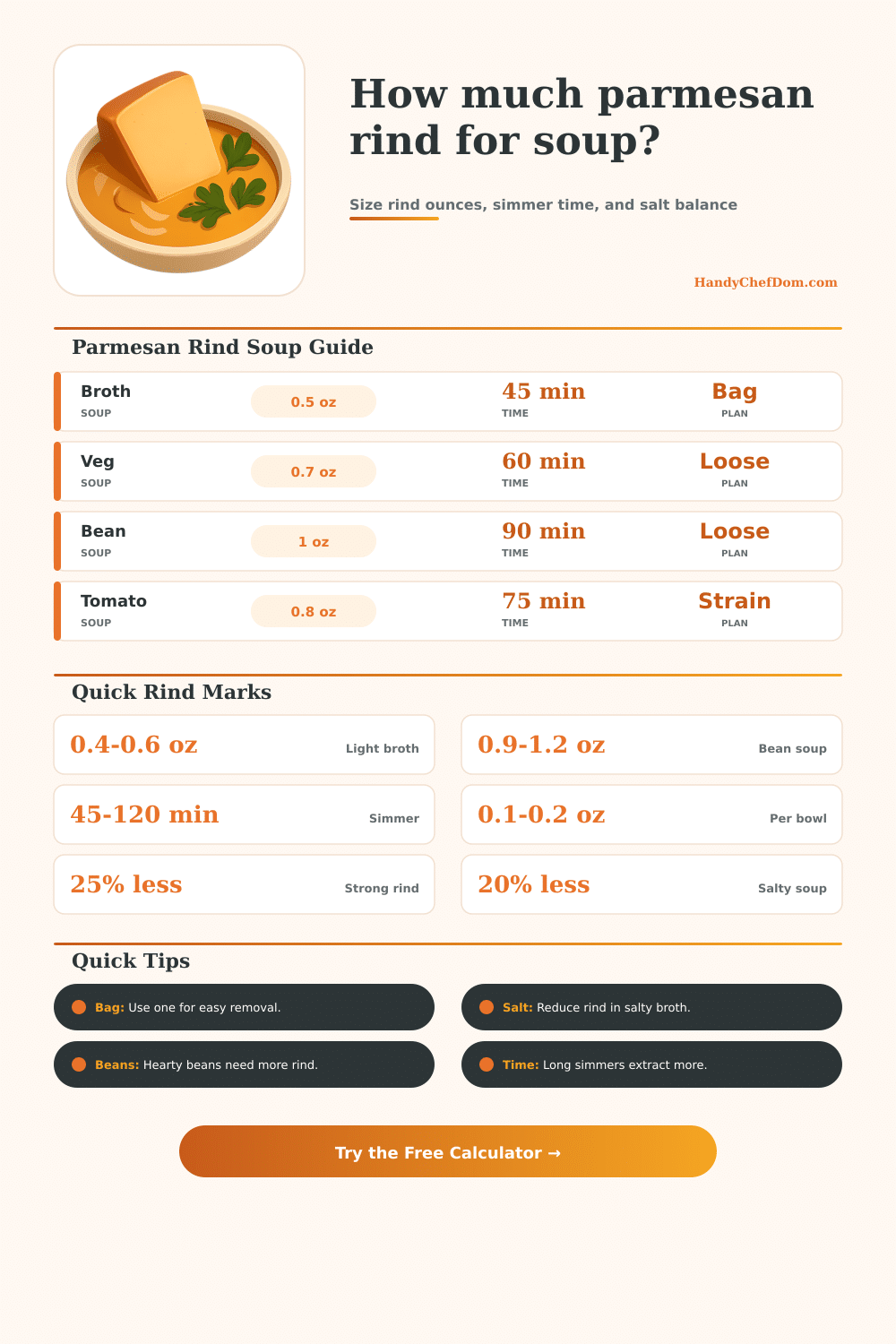
Parmesan rinds add savory depth, salty cheese aroma, and light body. This planner starts with rind ounces per quart, then adjusts for soup type, starch or beans, vegetable load, salt level, simmer extraction, and how strongly you want the rind to read.
Your Parmesan Rind Soup Plan
Adjust the soup volume, rind amount, simmer time, saltiness, beans, vegetables, intensity, and removal plan, then calculate.
Parmesan Rind by Soup Type
| Soup style | Starting rind per quart | Best simmer window | Flavor role | Adjustment cue |
|---|---|---|---|---|
| Clear chicken or vegetable broth | 0.40 to 0.60 oz | 35 to 60 minutes | Light savory backbone | Use less if the broth is already reduced |
| Vegetable soup | 0.55 to 0.80 oz | 45 to 75 minutes | Rounds out sweet vegetables | Use a bag if vegetables are delicate |
| Minestrone or pasta e fagioli | 0.70 to 0.95 oz | 60 to 100 minutes | Classic Italian soup depth | Beans and pasta can carry more rind |
| White bean or chickpea soup | 0.85 to 1.15 oz | 75 to 120 minutes | Salty umami and body | Start lower with canned salted beans |
| Lentil or split pea soup | 0.80 to 1.10 oz | 75 to 120 minutes | Deepens earthy legumes | Remove before blending smooth |
| Tomato soup | 0.65 to 0.90 oz | 50 to 90 minutes | Balances acidity with cheese savoriness | Do not oversalt until the end |
| Creamy potato or chowder-style soup | 0.55 to 0.75 oz | 45 to 80 minutes | Subtle dairy-like depth | Remove before heavy blending |
| Thick stew-like soup | 0.90 to 1.25 oz | 90 to 150 minutes | Concentrated savory base | Watch salt if the pot reduces hard |
Simmer Time and Extraction Guide
| Rind simmer time | Estimated extraction | Best soup match | Texture cue | Calculator effect |
|---|---|---|---|---|
| 15 to 30 minutes | 25% to 42% | Quick broth or last-minute rescue | Mostly aroma | Needs more rind for the same flavor |
| 35 to 60 minutes | 45% to 65% | Clear broth and vegetable soup | Clean savory note | Balanced for light pots |
| 75 to 100 minutes | 70% to 82% | Minestrone, tomato, beans | Strong savory extraction | Most reliable range |
| 110 to 150 minutes | 84% to 92% | Bean soup and stew | Full rind depth | Use less if salty |
| 180 minutes or more | 92% plus | Long stew only | May get assertive | Calculator flags salt caution |
Rind Condition and Removal Planning
| Rind or plan | Extraction behavior | Best use | Kitchen note | Calculator adjustment |
|---|---|---|---|---|
| Fresh flexible rind | Milder and creamy | Short soups, delicate broth | Can soften quickly | Slightly more rind |
| Stored firm rind | Balanced extraction | Everyday soup pot | Default planning assumption | Baseline |
| Very dry aged rind | Strong and salty | Beans, lentils, stew | Use less and taste late | Slightly less rind |
| Thick waxy outer rind | Slow and uneven | Long simmer only | Scrape visibly waxy surfaces | Needs more time or rind |
| Cheesecloth bag | Slightly gentler | Clear soups and easy cleanup | Pull the bag before serving | Small boost for containment |
| Strain soup base | Full extraction | Smooth tomato or broth base | Best if solids are removed anyway | Efficient extraction |
Common Pot Sizes
| Finished soup volume | Light broth rind | Vegetable or tomato rind | Bean soup rind | Typical servings |
|---|---|---|---|---|
| 2 quarts | 0.8 to 1.2 oz | 1.2 to 1.7 oz | 1.8 to 2.3 oz | 4 bowls |
| 4 quarts | 1.6 to 2.4 oz | 2.4 to 3.4 oz | 3.5 to 4.6 oz | 8 bowls |
| 6 quarts | 2.4 to 3.6 oz | 3.6 to 5.1 oz | 5.2 to 6.9 oz | 12 bowls |
| 8 quarts | 3.2 to 4.8 oz | 4.8 to 6.8 oz | 7.0 to 9.2 oz | 16 bowls |
| 12 quarts | 4.8 to 7.2 oz | 7.2 to 10.2 oz | 10.5 to 13.8 oz | 24 bowls |
Soup with Parmesan rind is an easy way to make it taste better. You’re making a pot of soup or beans on the stove. Oh, yeah: The rinds from those parmesans are still hiding in the fridge. How do I know how much and when? Will it get too salty? Why don’t I know these things? It’s the kind of uncertainty that turns a good pot into something you keep adjusting at the table.
How much rind should you use? That vary with the soup. For clear broths (which don’t have much else going on), a small amount of rind is sufficient. Thick soups made from legumes, like lentils or beans, can handles stronger flavors because the legumes will absorbs the flavor of the rind. Vegetable soups are somewhere in between: They’re sweet (from onions and carrots) and salty at the same time, and if there’s too much of the cheese flavor it’ll overwhelm everything else. That’s where the calculator comes in, adjusting for pre-salt contents, volume, and the starchiness of vegetable base.
How to Use Parmesan Rind in Soup
How long to simmer? Time matter almost as much as the initial quantity. More time extracts more flavor, which is great for a big pot to last multiple days. But a long cookdown also increases concentration of salt. Reduce the soup heavily; however, if it is already salty, the balance change. What tasted just perfect after 45 minutes might be too salty in another couple of hours.
How does the rind matter? A thicker waxy rind from the outside edge will soften gradually and require more space, or longer time, to give some punch. And a fresh supple rind will be salty but let go of flavor sooner then an older drier one. You can record that in the calculator. Instead of pretending we are working with perfect conditions, it changes its suggestion to match.
When? Usually on a whim. To clean up, use a cheesecloth bag because it releases less flavor into the broth. Leave rind loose for more extraction, then pick out soft bits before serving (particularly essential if there is delicate greens or small pasta in the soup). Strain all broth, as some do. Or scoop rind out and serve warning to diners that it’s still there. There are no right answers; your choice affects how much rind you use and how carefully you must season the finished dish.
A lot of people find salt tricky. In this recipe, parmesan rinds will contribute not just flavor but salt, which increase when the soup thickens. My best advice: don’t go overboard with salt until you know what it needs. Once the rind’s cooked into the soup, sample it to see if it needs anything more. Grated cheese on top at the table? Less rind initialy. But there’s no need for the guessing game when you plan ahead.
The rind is just another seasoning, treat it as such. You could of avoided the saltiness by planning. Know what you’re using, when to use it, and how long to cook it. Know when to taste it, too. This confidence will transform your leftovers into a valuble ingredient. Reach for the remaining scraps on purpose, not in hopes that it’ll work out.